How to Use First-Then Boards: A Practical Guide for Parents and Educators
See how a simple two-part visual can make activity sequences understandable at home, in classrooms, and in everyday life.
By Adaptive Strides Editorial Team · October 20, 2026 · Approximately 10-minute read
Making expectations easier to understand
Imagine a caregiver asking a child to put the toys away before going outside. The child might understand each activity separately yet still be unsure what is happening now, what comes next, or when the routine will change. Repeating the instruction louder or more often may not make the sequence clearer.
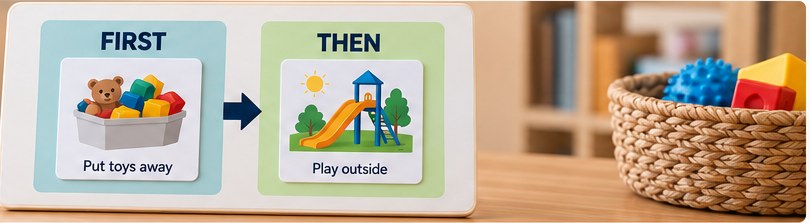
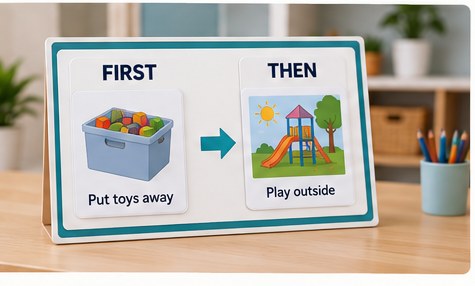
A First-Then board provides a visual answer. It shows two activities in order: first, put the toys away; then, play outside. Rather than relying only on spoken language, the learner can look at the board again whenever they need a reminder. A visual is an invitation to understand what comes next—not a substitute for listening to the learner's concerns or requests.
What is a First-Then board?
A First-Then board is a visual support that communicates the order of two activities, steps, or events. Usually the FIRST activity appears on the left and the THEN activity on the right. Both spaces can hold photographs, picture symbols, written words, or another accessible representation of what will happen.
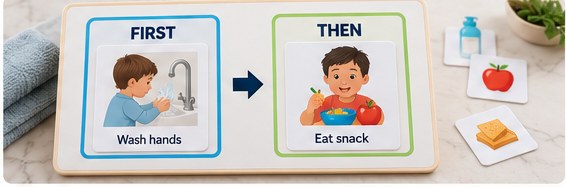
For example, a board can show washing hands followed by eating a snack. The message is not necessarily a reward promise: it simply tells the learner the next part of the routine. Some teams pair this structure with individualized reinforcement arrangements, but showing a sequence and reinforcing a behavior are different purposes.
Choose a format that makes sense to the individual. A learner who recognizes actual photographs may find photos easier than abstract icons. A fluent reader may prefer two short written labels. For someone with limited vision or other access needs, tangible items or adapted communication supports may be more useful. The board only helps if its information can be understood.
Why First-Then boards can be helpful
First-Then boards may reduce uncertainty about activity order, especially when directions are spoken quickly or when several adults are supporting the same routine. A stable visual can make transitions more predictable, provide a reminder without constant talking, and help the learner participate in checking the next activity.
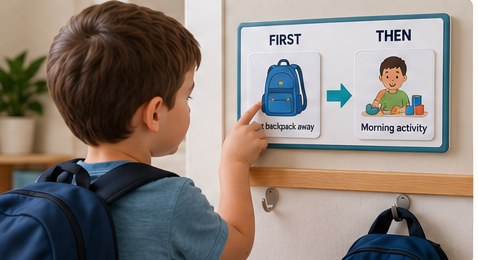
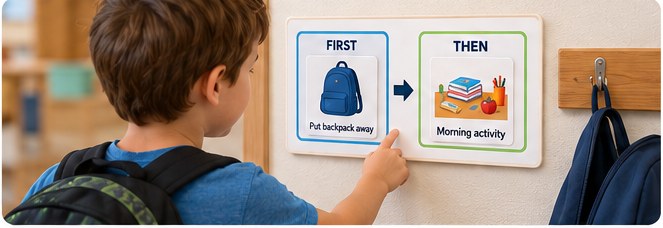
For example, a student entering a classroom may refer to a board showing FIRST put away backpack, THEN begin morning activity. Once familiar with the board, they might check it on their own. Adults can then reduce unnecessary spoken reminders while staying available to help when requested.
These potential benefits depend on the learner, the clarity of the materials, and the teaching used to introduce them. A First-Then board does not guarantee cooperation, independence, or the prevention of challenging behavior. If a learner becomes distressed, it is important to consider communication, sensory needs, timing, difficulty, and preferences—not simply insist that the board be followed.
How to create and introduce a First-Then board
1. Choose two real activities
Start with a familiar, short sequence: FIRST wash hands, THEN eat lunch; or FIRST put shoes on, THEN go outside. Only show activities that will actually happen. Avoid using a preferred THEN activity as a promise if it cannot be provided.
2. Select accessible visuals
Use simple photographs, recognizable pictures, text, or appropriate objects. Check that the learner can identify what each picture means. When possible, involve the learner in choosing the images or language.
3. Arrange the board clearly
Put FIRST on the left and THEN on the right, with one large picture per space. Keep background details minimal and make labels legible. Laminated paper, cardboard, a tablet, or magnetic cards can all work; there is no requirement to purchase specialized materials.
4. Introduce it before the sequence
Point to the first picture and briefly explain it, then point to the second. For example: “First brush teeth. Then get dressed.” Allow time for the learner to look, ask, or respond using their preferred communication method.
5. Model the routine and follow through
Use the board during the activities rather than displaying it once and forgetting it. Refer to FIRST during the initial activity and then move attention to THEN when it is time to transition. You can remove a completed card or mark it finished if that helps the learner.
6. Individualize and adjust
Notice whether the board is understood, whether its location is useful, and whether adult prompting can gradually be reduced. Change the pictures, number of spoken cues, sequence, or activity demands when necessary. Support requests for breaks, assistance, or alternatives.
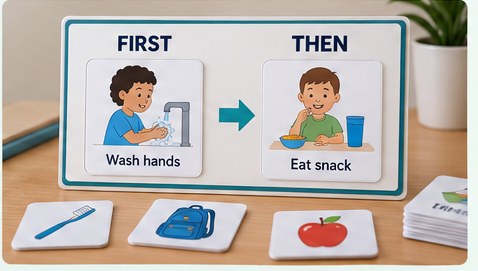
Try the board during a routine the learner already knows before introducing it at a more difficult transition. Model how to look at both pictures and allow time to respond. The goal is understanding and increasing useful independence, not requiring a particular display of compliance.
First-Then boards at home
Home routines offer many opportunities to show a short sequence without making an entire day's schedule. For a morning routine, a caregiver might show FIRST brush teeth, THEN get dressed. During cleanup, the board could show FIRST put toys in the bin, THEN choose the next activity. Before lunch, it might show FIRST wash hands, THEN eat.
The board is most helpful when the activities are specific and realistic. “Be good” is too vague to illustrate clearly, whereas “put blocks in the box” is observable. Similarly, THEN should reflect the actual plan; it need not always be a prize. If the next activity changes, update the board and let the learner know.
First-Then boards in the classroom
Educators can use a board to communicate a short instructional sequence, such as FIRST complete a matching activity, THEN draw a picture. It can also help with arrival routines, moving between centers, organizing materials, and preparing for transitions. The activity descriptions should align with classroom expectations and the learner's educational goals.
A teacher may show the board before independent work, refer to it once as the activity starts, and allow the student a chance to check it independently. If the activity is too long or demanding, breaking it into a manageable portion may be more useful than adding prompts. Remember that opportunities to request assistance and participate in choices remain important.
Common mistakes and helpful adjustments
- The pictures are unfamiliar. Try real photographs of the learner's materials or activities and confirm recognition before using the board.
- The board appears without instruction. Briefly teach the meaning of FIRST and THEN during a comfortable, familiar routine.
- The plan changes but the board does not. Replace the card and explain the new sequence so the visual remains trustworthy.
- Adults prompt immediately. Give sufficient processing time and reduce unnecessary reminders as understanding develops.
- The learner resists an activity. Explore difficulty, discomfort, preferences, timing, and communication needs rather than treating the board as a demand to obey.
Visual design matters too. Two large, recognizable pictures may be easier to interpret than a crowded page containing many tiny symbols. However, no one layout fits everybody; choose the level of detail and format that match the individual learner's needs.
First-Then boards vs. visual schedules
Both supports show an activity sequence. The main distinction is how much information appears at once: a First-Then board typically displays two activities, while a broader visual schedule may show several steps of a routine or a longer part of the day.
| Feature | First-Then board | Visual schedule |
|---|---|---|
| Activities shown | Usually two | Two or more, often several |
| Typical use | Immediate sequence or transition | Extended routine or series of events |
| Detail | Focused on what is next | Can provide a longer overview |
| Example | Brush teeth → Get dressed | Brush teeth → Dress → Breakfast → Backpack → School |
A First-Then board can be used as part of a larger visual schedule. For instance, a learner may have a five-part morning schedule but reference a two-part board to focus on the next transition. Learn more in our guide to visual schedules.
When to move beyond a First-Then board
Some learners prefer to see the entire plan in advance. As they become comfortable with short sequences, they may want a longer visual schedule, written checklist, or digital calendar. Others continue to find First-Then boards useful over time, including teens and adults. The right level of support depends on comprehension, task complexity, personal preferences, and accessibility—not age alone.
Before increasing complexity, ask whether the learner actually benefits from more information. Adding extra pictures can sometimes create confusion rather than independence. Follow the individual's needs and allow a choice of tools when feasible.
Related educational resources
Explore the Visual Supports, Schedules, and Task Cards categories in the Adaptive Strides Shop. These are existing shop categories; no specific product is required to make a First-Then board.
Frequently asked questions
What is the purpose of a First-Then board?
It visually communicates the order of two activities so the learner can see what happens first and what follows.
Are First-Then boards only for autistic children?
No. They may benefit people of different ages and support needs who find two-part visual sequences useful.
How do you introduce a First-Then board?
Begin with recognizable activities, show both pictures, explain them briefly, and model checking the board during the routine.
What if a learner does not respond to it?
Check comprehension, accessibility, activity demands, and whether the visual reflects the actual routine. Adjust the tool rather than assuming the learner is unwilling.
How is it different from a visual schedule?
A First-Then board focuses on two steps. A broader schedule may show a longer sequence across a routine or day.
Can teenagers or adults use First-Then boards?
Yes. Visual supports should be chosen based on preferences and support needs, with age-respectful wording and design.
Conclusion
A First-Then board is a modest tool with a clear purpose: helping someone understand the immediate sequence of activities. Its value comes from recognizable visuals, accurate expectations, accessible placement, and respectful teaching. Start with a meaningful routine, see how the learner responds, and adapt from there. Explore other Adaptive Strides Learning Hub guides for more practical supports.
References and further reading
- National Clearinghouse on Autism Evidence and Practice (2020). Evidence-Based Practices for Children, Youth, and Young Adults with Autism. NCAEP resources.
- AFIRM Modules, UNC Frank Porter Graham Child Development Institute. Visual Supports professional learning resources.
- National Professional Development Center on Autism Spectrum Disorders. Visual Supports Evidence-Based Practice Brief. ERIC entry.
This article provides general educational information, not individualized behavioral or clinical treatment advice.