
What Is Task Analysis in ABA? A Step-by-Step Guide for Teaching Everyday Skills
See how one complicated routine becomes a series of small, observable actions—and how to teach those actions in a way that fits the learner.
By Adaptive Strides Editorial Team · October 20, 2026 · Approximately 9-minute read

Making everyday skills easier to learn
Imagine a child getting ready for school. They can brush their teeth, put on a shirt, and find their backpack—but the whole morning still requires repeated reminders. Maybe they lose track of what comes next, miss an important step, or stop when the routine becomes overwhelming.
That doesn’t necessarily mean they cannot do the skill. The challenge may be organizing several actions into a complete routine. Breaking a larger activity into smaller, teachable parts can help adults identify precisely where support is needed and help the learner see their progress. In Applied Behavior Analysis (ABA), this process is called task analysis.
What is task analysis in ABA?
Task analysis is the process of identifying and arranging the smaller, observable actions that make up a more complex skill. It is a description of the task—not, by itself, a complete teaching method. An educator or caregiver can then use the sequence to teach, prompt, practice, and measure each component.
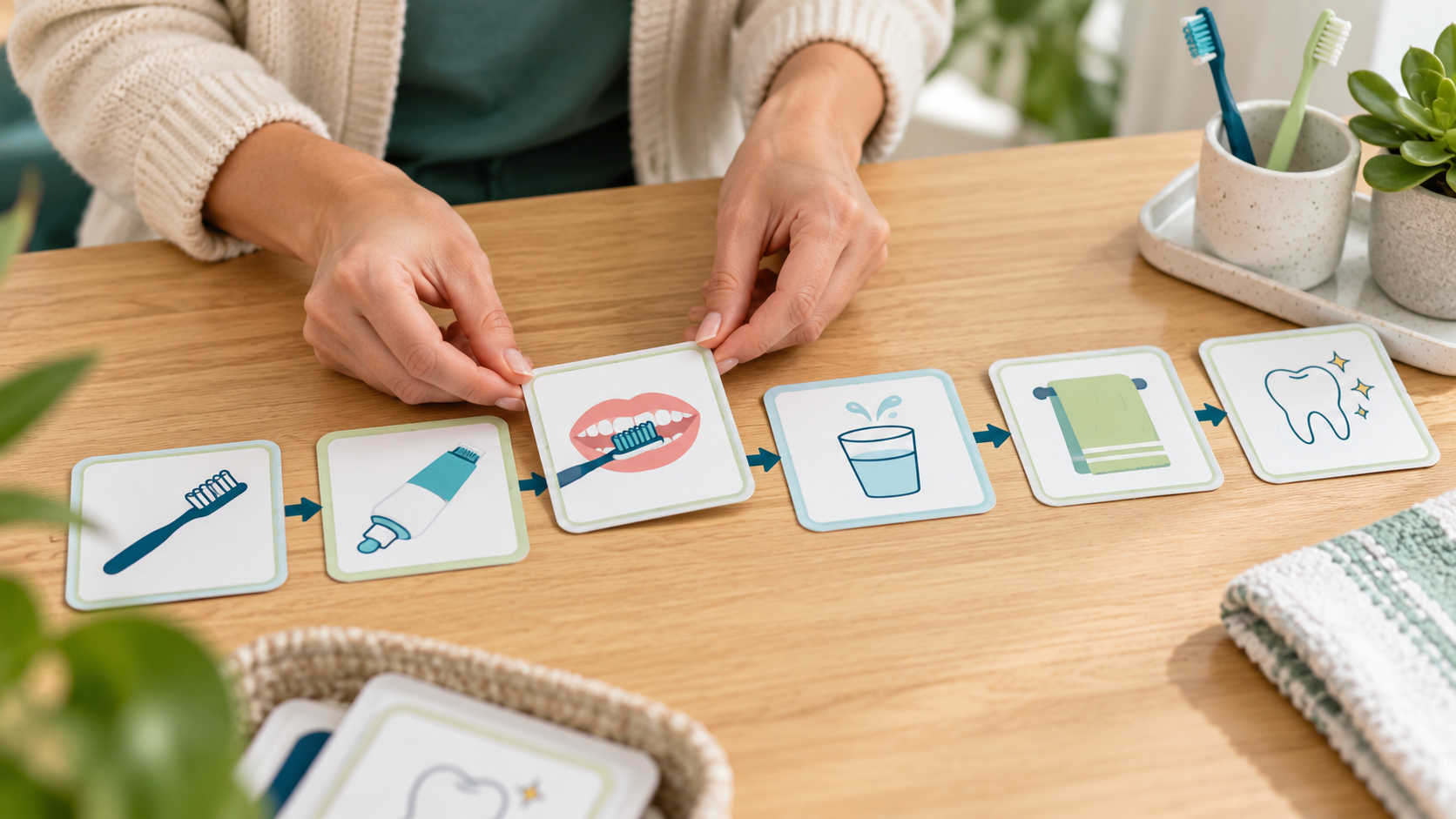
For example, “brush your teeth” may sound like a single direction, but it includes gathering materials, preparing the toothbrush, brushing, rinsing, and putting things away. Each part can be described so that two adults observing the routine know what completion looks like.
- Pick up toothbrush.
- Apply toothpaste to the toothbrush, with assistance if needed.
- Brush the front, back, and chewing surfaces as appropriate.
- Spit out toothpaste, when appropriate.
- Rinse the toothbrush and put it away.
Real toothbrushing plans may need more detailed steps, accessible equipment, and individualized dental or safety guidance. This short example only shows how a larger skill can be divided.
There is no universally correct number of steps. A learner who already knows the routine might use three broad steps; someone learning the task for the first time may need ten or more precise actions. A learner’s motor abilities, communication, environment, preferences, and available supports all matter.
Why is task analysis important?
Task analysis can improve the clarity and consistency of teaching. Rather than saying someone “needs help with mornings,” the team can identify whether the hard part is starting, sequencing, using materials, or finishing. That makes the next instructional decision more specific.
It can support adaptive skills such as dressing, hygiene, household responsibilities, preparing a snack, and classroom routines. It also helps different caregivers and educators use a shared sequence, reducing mixed directions from one setting to another.
Another benefit is step-level progress monitoring. Instead of recording only whether the entire task was completed, adults can note which steps were independent, which required prompts, and where materials or the environment created barriers. This helps avoid prompting steps that the learner can already perform independently.
Task analysis does not automatically guarantee independence or reduce distress. If a task remains difficult, it may be necessary to change the steps, make the environment more accessible, offer choices, or reconsider whether the skill is meaningful to the learner.
How to create a task analysis: seven practical steps
1. Choose a meaningful skill
Start with a goal that will make a genuine difference in the learner’s day, such as packing a bag, washing hands, setting a table, or completing a classroom arrival routine. Include the learner’s preferences and priorities when possible.
2. Observe how the skill is actually performed
Complete the task yourself, watch a competent model, or observe the learner attempting it. Notice materials, timing, environmental cues, and what must happen in sequence. Avoid writing an idealized routine that does not fit the setting.
3. Break the skill into observable steps
Use concrete actions: “pick up lunchbox” is easier to observe than “be responsible.” Keep steps small enough to teach but not so tiny that the routine becomes unnecessarily complicated.
4. Put the steps in a logical order
Sequence matters. For packing a backpack, finding required materials comes before putting them inside and closing the zipper. Some routines allow flexible orders; your task analysis should reflect that flexibility instead of enforcing arbitrary precision.
5. Test and adapt the sequence
Walk through every step. Is anything missing? Does the learner need a grip adaptation, picture cue, alternative communication method, or change in the location of supplies? Update the analysis before teaching if the sequence is inaccessible.
6. Select how to teach the routine
Decide whether to model the sequence, use prompts, teach one step at a time, or support the whole task. Give the learner time to respond, honor communication and refusal, and reduce unnecessary help as learning develops.
7. Collect useful step-level information
Record what occurred independently and what needed assistance. Check across days and environments—not just one successful attempt—before deciding the learner has mastered the routine.
Task analysis vs. chaining: what is the difference?
The two terms often appear together, but they are not interchangeable. Task analysis describes the sequence. Chaining is a teaching strategy that connects the steps into a complete skill.
| Teaching approach | What it looks like |
|---|---|
| Forward chaining | Teach the first step to independence, then add the next step in sequence. |
| Backward chaining | Support earlier steps and teach the final step first, then add preceding steps. |
| Total-task presentation | Have the learner practice the full sequence, providing prompts for individual steps as needed. |
For handwashing, forward chaining might begin with turning on the water. Backward chaining might first focus on drying hands as the final action. Total-task teaching would provide opportunities to complete the whole routine, with individualized support where necessary. A trained professional should guide the choice when a learner has an individualized behavior-support program.
Task analysis in real life

At home: Getting dressed
A caregiver notices that a child can put on clothing but has trouble selecting items in order. A simple task analysis may include collecting clothes, putting on underwear, putting on pants, putting on a shirt, and putting on socks. The adult can offer a visual checklist and identify whether the difficulty is with finding items, sequencing, or the motor parts of dressing. The goal is participation and independence—not enforcing a particular clothing preference.
At school: Classroom arrival
A teacher creates a classroom arrival sequence: enter, place backpack in cubby, hand in folder, check the schedule, begin the first activity. When staff use the same prompts and visuals, the learner receives more consistent information. The teacher may track which steps happen without reminders and whether a step should be moved or simplified.
In the community: Checking out a library book
A portable task analysis could include finding a book, bringing it to the checkout area, presenting a library card or using a supported checkout method, and carrying the book home. Community routines sometimes change, so the learner may also need a way to ask for help, choose a different option, or handle an unexpected step.
For older learners: Completing a weekly chore
A teenager learning to vacuum a room might benefit from a task analysis that includes gathering the vacuum, checking the cord or battery safely, clearing small obstacles, cleaning accessible areas, putting equipment away, and marking the task complete. Asking the teen which part they want to try first makes the process more collaborative.
What might progress tracking look like?
A simple data sheet can list each step down the side and each practice date across the top. For every step, record whether it was independent, completed with a prompt, or not completed. Define what each code means before collecting data so adults use the same standard.
Example Observation Sheet
Fictional example — not an actual client record
| Pack backpack | Observation |
|---|---|
| Find folder | Independent |
| Place folder inside | Independent |
| Add lunchbox | Verbal prompt |
| Close zipper | Independent |
This example suggests the learner may need help finding or remembering the lunchbox step, rather than being prompted through the entire routine.
Common challenges and helpful adjustments
Too many steps? Combine well-known actions or teach only a short portion at a time. Steps too broad? Break down the point where assistance is needed. Prompt dependence? Review whether adults are helping before the learner has time to try. Inconsistent performance? Check environmental factors, materials, motivation, fatigue, and opportunities for choice.
If a learner resists or becomes distressed, do not assume they simply need more practice. Consider sensory needs, discomfort, difficulty understanding the task, inadequate communication supports, or a goal that does not match their priorities. Instruction should be compassionate and adaptable.
Related educational resources
Explore Task Cards, Checklists, and Visual Supports in the Adaptive Strides Shop. These are category pages; no individual product is implied to be available yet.
Frequently asked questions
Is task analysis only for children with autism?
No. Breaking skills into clear actions can help people of different ages and support needs, including learners who benefit from structured instruction.
Is a task analysis the same as a visual schedule?
No. A task analysis defines the component actions of a skill. A visual schedule communicates the order of activities or steps; it may be created from a task analysis.
Should every learner use the same steps?
No. Steps should fit the person, environment, accessible tools, communication preferences, and the goal's purpose.
How do I know when to fade prompts?
Review performance across repeated opportunities. Fade only when the learner has a realistic opportunity to respond and still has support available when needed.
Continue learning
See What Is a Visual Schedule and How Do You Use One? for an example of how visual information can support routines, or browse the Learning Hub for other articles.
References and further reading
- Cooper, J. O., Heron, T. E., & Heward, W. L. (2020). Applied Behavior Analysis (3rd ed.). Pearson. Task analyses and chaining procedures.
- National Clearinghouse on Autism Evidence and Practice (NCAEP). Evidence-Based Practices for Children, Youth, and Young Adults with Autism (2020). See the resources on task analysis and related instructional approaches.
Adaptive Strides provides general educational information, not individualized clinical instruction. Use individualized plans and professional guidance where appropriate.