
How to Teach Morning Routines to Children with Autism: A Step-by-Step Guide
Practical ways to make busy mornings more predictable, comfortable, and manageable—with the right level of support for each child.
By Adaptive Strides Editorial Team · October 20, 2026 · Approximately 10-minute read
Why mornings can feel challenging
Imagine a family getting ready for school. One child is looking for a favorite shirt while someone else is making breakfast. There is a toothbrush to find, a backpack to pack, and a departure time approaching. A child may know how to complete each individual activity but have difficulty starting, remembering the order, or moving between them without reminders.
For some autistic children, unexpected changes, sensory discomfort, communication differences, sleep difficulties, or too many demands at once can add to these challenges. Other autistic children may enjoy familiar routines and move through mornings comfortably. No single routine or teaching method fits everyone. The goal is to understand what matters to this child and family and make participation easier—not to insist on perfect compliance.
1. Observe the current routine first
Before creating a new schedule, watch what already happens. Notice what the child starts independently, where they ask for help, which steps they enjoy, and when they seem unsure or uncomfortable. A routine that looks like a skill difficulty may actually involve fatigue, difficult clothing fasteners, a loud bathroom fan, or not knowing where materials are kept.
Try observing two or three mornings without changing everything. Write down the activity, how the child participates, and what support was useful. Include communication through speech, gestures, pictures, or an AAC system. Ask the child for their preferences in a way they can access.
What is working already?
| Activity | Independent | Support helpful |
|---|---|---|
| Choose clothes | ✓ | — |
| Brush teeth | — | Help preparing toothbrush |
| Pack backpack | — | Picture checklist |
This is a fictional example, not a client record. The aim is to identify useful support, not label the child as successful or unsuccessful.
2. Separate the schedule from the steps within a skill
A visual morning schedule shows the order of activities, such as get dressed, brush teeth, eat breakfast, and pack backpack. A task analysis breaks one activity into its smaller actions. Getting dressed might include choosing clothes, putting on a shirt, putting on pants, and then socks and shoes. Keeping these two levels separate helps avoid an overwhelming schedule.
- Get dressed
- Brush teeth
- Eat breakfast
- Pack backpack
- Choose clothing
- Put on shirt
- Put on pants
- Put on socks
- Put on shoes
A schedule answers “what comes next?” Task analysis answers “what actions make up this activity?” Read our Task Analysis guide for a more detailed explanation.
Match the level of detail to the learner. Someone may need just one cue to dress, while another person benefits from four picture cards, adapted clothing, or continuing physical assistance. Breaking skills into steps is a planning tool, not a guarantee of independence.
3. Create a predictable, flexible morning schedule
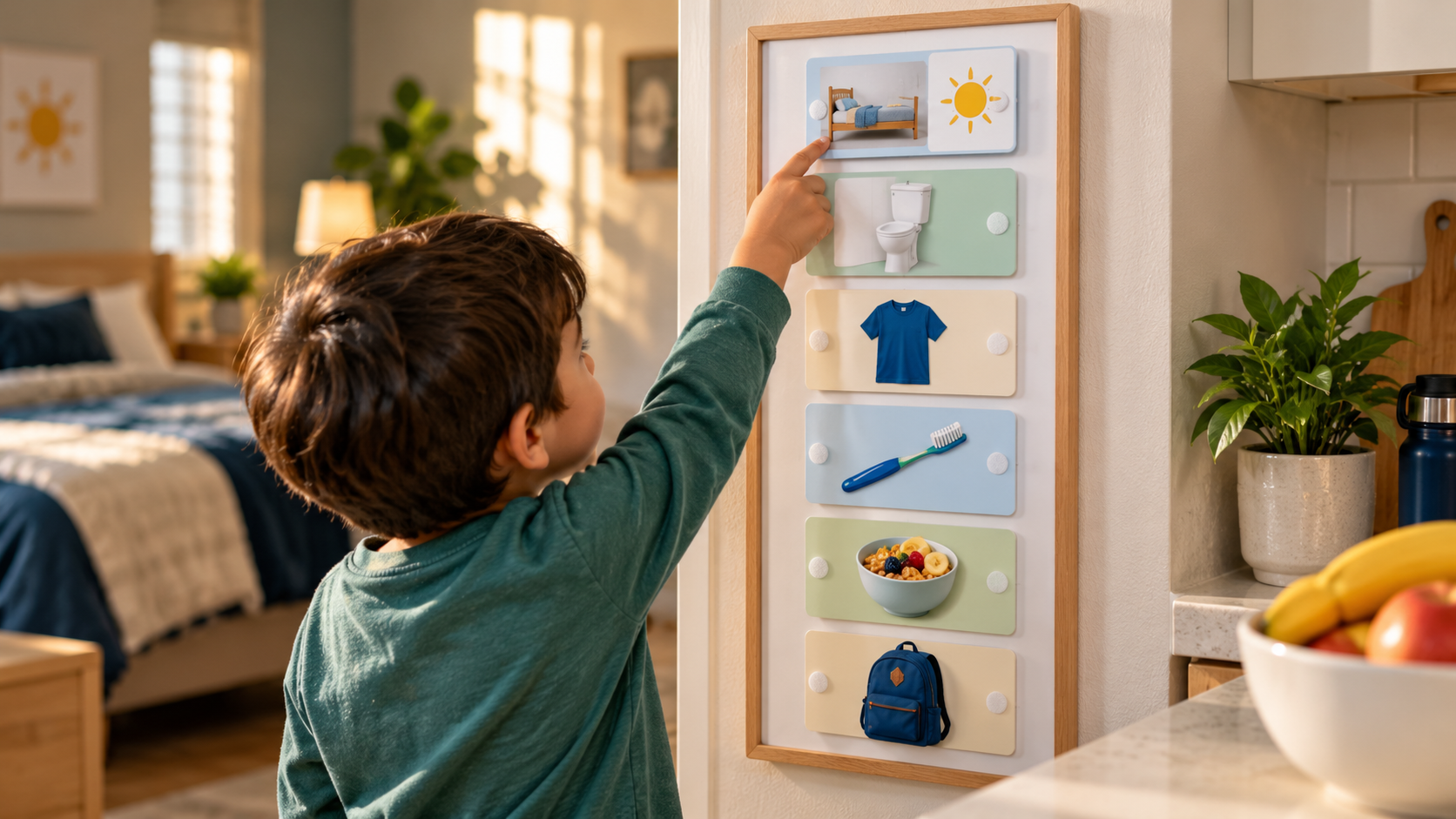
Start with the activities the family genuinely needs. Arrange them in a realistic order, using pictures, photos of familiar objects, written words, tactile cues, or a digital device—whichever format the child understands. Put the schedule somewhere accessible, introduce it before or during the routine, and point back to it naturally. Some families move finished cards into a pocket; others mark a checkbox.
Keep the sequence honest. If a medical appointment changes departure time, show the change and explain it in a way the child understands. Some learners prefer a full six-step schedule; others do better when only two upcoming activities are visible. Both choices can be appropriate.
The order above is illustrative; a child's own schedule may use different activities and timing.
For more examples of choosing visual formats, see our Visual Schedules guide.
4. Teach one skill at a time
Trying to change a whole morning at once can create extra pressure. Instead, choose one meaningful, achievable goal with the child: putting on shoes with less adult reminding, finding the toothbrush, or packing two items into a bag. Observe which parts they already know and teach only the part where help is needed.
Model the action, offer appropriate prompts, and allow enough processing and response time. If physical assistance is needed, attend to the child's comfort, assent, and communication. Praise or reinforcement should be individualized and meaningful; completing a task is not more important than dignity, safety, or access to essential needs.
Getting dressed: simple checklist
Use as a visual cue only if this format is recognizable and helpful; adapt steps, sequence, and clothing access needs.
Over time, look for changes that matter to the family and child: perhaps the child begins selecting clothes, finds materials more easily, or requests help sooner. Some children will continue to use schedules or human support long term, and that can still represent meaningful success.
5. Use First-Then boards for shorter sequences
If seeing an entire morning feels overwhelming, a First-Then board may be easier to process. It shows only two activities in order: first brush teeth, then get dressed; or first put on shoes, then get backpack. It communicates what comes next and is not inherently a reward or compliance system.
Choose recognizable images and ensure the next activity actually follows. Learn more in our First-Then Boards guide.
6. Make sensory and environmental adjustments
A schedule cannot solve discomfort caused by scratchy tags, bright lights, toothbrush bristles, toothpaste taste, a noisy fan, or being rushed. Offer choices where possible: two comfortable shirts, a softer toothbrush, different toothpaste flavors, a quieter bathroom, or extra time to wake up. Arrange school items the night before to reduce morning time pressure if that is useful for the family.
These are options to explore, not universal recommendations. Follow health and dental guidance where relevant.
Distress is important communication. If a child resists an activity, investigate what makes the experience difficult instead of simply increasing demands or prompts. Predictability helps some children, but comfort, autonomy, and choice remain central.
7. Build motivation around meaningful participation
Learning is often easier when the goal has a useful outcome. For example, packing a backpack can mean the child knows their favorite book will be available later. Involving the learner in choosing breakfast items, the order of flexible activities, or a preferred song during dressing can make the routine more collaborative.
Encouragement, naturally occurring outcomes, and individualized reinforcement may support a developing skill. But do not withhold food, bathroom access, comfort, communication devices, or needed assistance to make a child follow a schedule. A child should be able to request a break, help, or a change when necessary.
8. Troubleshoot what is getting in the way
Skipping steps: Check whether the visual is clear, the steps are understood, and the materials are available. Many adult reminders: Teach how to check the schedule and consider waiting briefly before prompting. Morning runs long: Reduce unnecessary steps, prepare some items earlier, or adjust expectations. Distress at transitions: Review sensory needs, communication, preferences, uncertainty, and physical discomfort. Different results in different settings: The same skill may need practice with different people, materials, or spaces; this is part of generalization, not evidence that the child has failed.
Neither format is inherently better. Choose the amount of detail that makes the routine more accessible.
9. Track progress without turning home life into a data project
When trying a new teaching strategy, choose one or two measures that help answer a real question: Can the child start the activity with fewer reminders? Which step still requires help? Is the routine more comfortable? Consider independence, type of prompt, engagement, accessibility, and time only if timing is a meaningful priority.
Brief morning routine observations
| Activity | Mon | Tue | Wed | Thu | Fri |
|---|---|---|---|---|---|
| Dress | I | I | H | I | I |
| Brush teeth | H | H | H | I | H |
| Pack bag | P | P | I | P | I |
Illustrative codes: I = independent, P = prompted, H = help provided. Agree on definitions before using this type of tracker. Keep personal information private.
Use observations to adjust the environment or teaching—not to pressure a child. For example, if toothbrushing still requires assistance, try breaking down that one part of the sequence or reviewing whether tools are accessible.
10. Example of a flexible morning routine plan
Here is one possible way to pair routine activities with useful supports. Adapt it to the learner's communication, schedule, access needs, and family priorities.
| Activity | Support | Teaching focus |
|---|---|---|
| Get dressed | Picture checklist | Follow steps with appropriate support |
| Brush teeth | Task analysis | Learn the sequence |
| Eat breakfast | Visual schedule | Know what follows |
| Pack backpack | Short checklist | Organize items |
| Prepare to leave | First-Then, if useful | See the next transition |
Frequently asked questions
How do I create a morning routine for an autistic child?
Observe the current routine, select meaningful activities, involve the child in choices, and introduce only the supports that make the sequence easier to understand or complete.
What if a visual schedule is not working?
Check whether the child understands its pictures, can access it, and finds the activities tolerable. Try fewer steps, real photographs, written cues, or another format.
How can I teach getting dressed more independently?
Identify which steps already work, teach a manageable missing step, and adapt clothing or equipment when needed. Continuing assistance may be appropriate.
Does the order have to be the same every day?
No. A familiar sequence can be helpful, but it should remain flexible and reflect real family needs.
What happens when the schedule changes?
Update the visual, explain the change accessibly, and offer choices or preparation time when possible.
Can morning routines be taught without visual supports?
Yes. Some children prefer verbal information, demonstrations, familiar routines, or other communication supports. Visuals are an option, not a requirement.
The goal is meaningful participation
Teaching morning routines is not about achieving a perfectly controlled morning. Start with the child's current strengths, build skills in manageable steps, use accessible communication and sensory accommodations, and adjust supports based on what genuinely helps. Predictability, comfort, choice, and functional participation are all worthwhile outcomes.
References and further reading
- Steinbrenner, J. R., et al. (2020). Evidence-Based Practices for Children, Youth, and Young Adults with Autism. National Clearinghouse on Autism Evidence and Practice, University of North Carolina at Chapel Hill. NCAEP resources.
- AFIRM. Visual Supports: Evidence-Based Practice Brief Packet, Frank Porter Graham Child Development Institute.
- Centers for Disease Control and Prevention. Signs and Symptoms of Autism Spectrum Disorder.
Educational information only, not individualized clinical advice. Examples are fictional and should be adapted to each learner's needs and preferences.