How to Teach Children to Ask for Help: Building Self-Advocacy and Independence
Practical, respectful ways to recognize help requests, teach accessible communication, and strengthen self-advocacy in everyday routines.
By Adaptive Strides Editorial Team · October 21, 2026 · Approximately 7-minute read
Learning when and how to ask for help
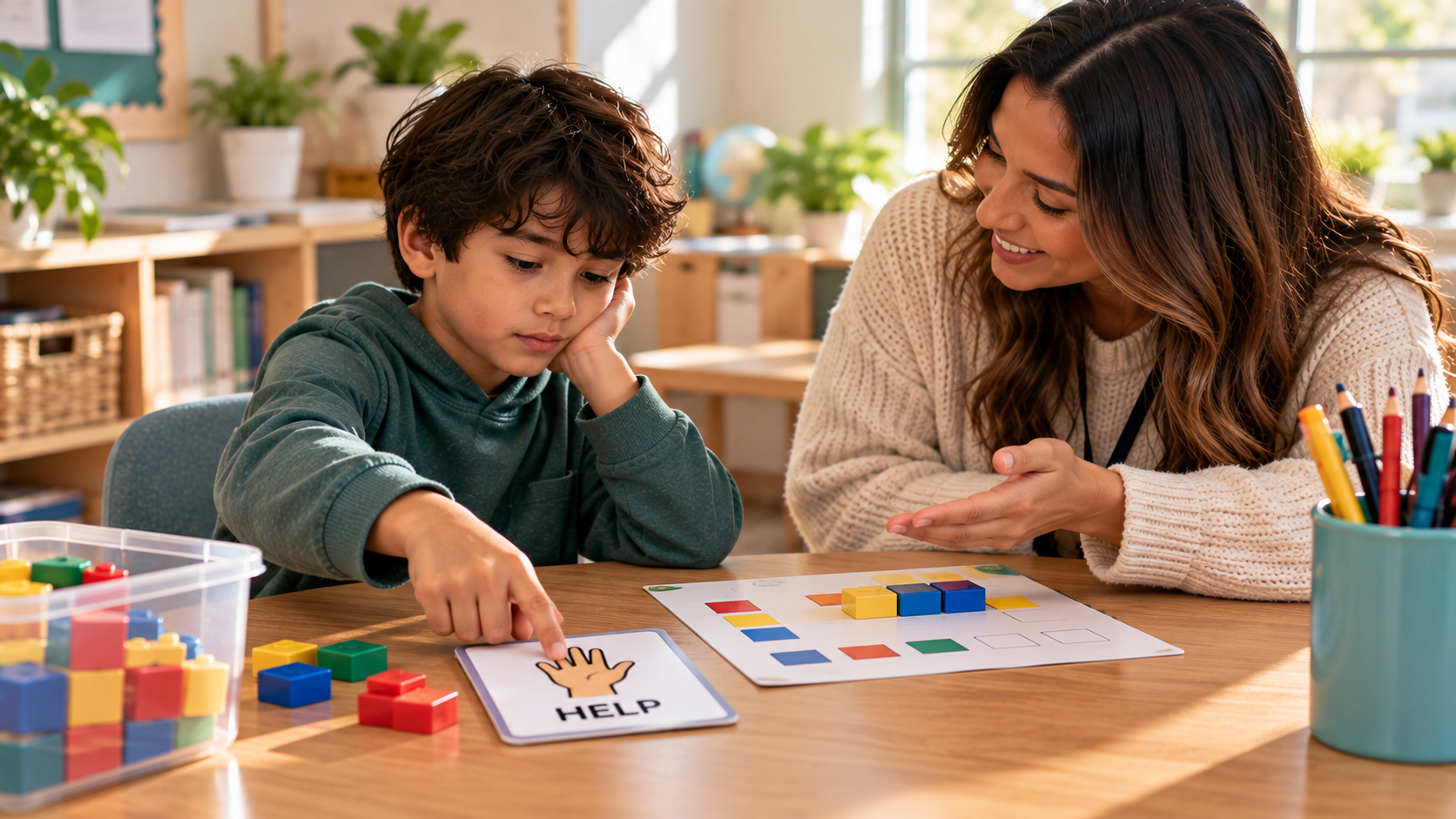
A student is working on a worksheet when an unfamiliar question appears. They stop, look around, and put down their pencil. An adult may see unfinished work, but the student may be communicating uncertainty or needing assistance. Children may already request help through gestures, speech, or AAC. Teaching children to ask for help begins with noticing those existing signals and making support accessible. The goal is to express needs and obtain assistance.
Help-seeking and self-advocacy: what is the difference?
Help-seeking means communicating that assistance would be useful and accessing appropriate support. Self-advocacy is broader: expressing needs, preferences, choices, boundaries, and rights, and participating in decisions that affect you. A child might request an explanation, more time, an accessible format, or a break. Spoken words are not required for a request to count.
Example: self-advocacy communication board
Why asking for help supports independence
Independence does not require doing everything alone. A learner may independently notice a problem, choose whom to ask, describe the kind of assistance needed, or direct someone to provide an accommodation. These abilities support learning, safety, and daily living. Asking for clarification is also problem-solving. Never require a child to attempt an unsafe or inaccessible activity alone to demonstrate independence.
How to teach children to ask for help
1. Recognize existing communication
Watch for words, gestures, pauses, facial expressions, and AAC messages that may signal uncertainty. Check what the learner means rather than assuming a lack of cooperation.
2. Choose meaningful opportunities
Use naturally occurring moments when help would be useful, such as a difficult puzzle or unfamiliar direction. Do not withhold necessary assistance or create distress simply to prompt a request.
3. Select an accessible response
Offer a spoken phrase, sign, gesture, picture card, written message, or AAC selection that works for the learner. Coordinate with the person's communication team when appropriate.
4. Model and support the request
Demonstrate how to communicate “Help,” “Show me,” or “I need more time.” Use individualized prompts if needed, then allow processing time and opportunities for spontaneous requests.
5. Respond meaningfully
When a request occurs, provide useful assistance or explain what support is available. Respect requests for breaks and accommodations. A response that never leads to help is unlikely to be a dependable communication tool.
6. Practice across everyday settings
Use different activities, partners, and environments. Gradually reduce unnecessary adult reminders, while keeping needed communication supports available. Celebrate effective self-advocacy, not a particular speaking style.
Functional help-seeking sequence
Using visual supports and AAC
Help cards, written reminders, communication boards, classroom signals, and speech-generating devices can all provide access to assistance. Select supports based on the learner's language, vision, movement, and preferences. Some people point; others use eye gaze, partner-assisted scanning, switches, typing, or speech. ASHA emphasizes multimodal communication and individualized access. Picture cards may supplement—not replace—a robust AAC system. Communication access should never be treated as a reward.
Different accessible ways to request assistance
Practice at home, school, and in the community
At home: A child cannot find the soap during a handwashing routine. A caregiver notices the child's gesture, names the need, and offers a familiar way to request help. The caregiver then assists with locating the soap.
At school: A student does not understand the first question on an assignment. A desk-level help card or AAC message makes it easier to request a demonstration, repetition, or example. The teacher responds with the requested clarification rather than insisting on an exact phrase.
In the community: A learner cannot locate an item on a shopping list. They approach an appropriate staff member with a trusted support person when needed and ask where the item is. Practice with familiar partners first.
Fade adult prompts, not communication access
At first, a teacher might point toward an available Help card when a student appears confused. Later, the student may begin using that same card without the teacher's gesture. This is a reduction in adult prompting, not a reason to remove the card. Prompt fading should be individualized and responsive to the learner's needs. If requests decrease, revisit the teaching plan and access method.
Same communication support, less adult prompting
Teacher points to the Help card during the assignment.
Student selects the same Help card without a reminder.
Common mistakes and helpful adjustments
Common barriers include overlooking nonverbal requests, waiting too long to respond, demanding speech when another method works, or creating unnecessarily difficult tasks. Respond promptly, model without pressure, simplify confusing directions, and preserve AAC access. A request for more time or a different way to participate is not automatically avoidance. Check whether the task, environment, or available supports need adjustment.
Measuring meaningful progress
Look beyond the number of requests. Consider whether the learner can communicate independently or with useful supports, use help requests across activities and partners, choose different forms of assistance, and actually receive the help requested. Notice whether the learner reports feeling understood, when that feedback is accessible. The goal is reliable access to support when needed.
Related Adaptive Strides resources
Explore our guides to functional communication, prompting and prompt fading, choice boards, and independent task completion. Products will be linked when available in the shop.
Frequently asked questions
How can I teach a child to ask for help?
Recognize existing signals, model an accessible request during a real need, and respond with useful assistance.
What if a child does not use spoken language?
Accept gestures, signs, pictures, typing, and AAC. Collaborate with the communication team to support access.
How does asking for help support independence?
It enables a person to identify needs, direct support, and participate in meaningful activities.
How can teachers encourage self-advocacy?
Offer communication options, honor requests for accommodations, and make classroom supports reliably available.
What if a learner asks for help with a familiar task?
Check for fatigue, uncertainty, anxiety, or a changed task demand. Offer assistance without shaming the request.
Conclusion
Teaching help-seeking begins by respecting how learners already communicate. Meaningful practice, accessible supports, clear models, responsive adults, and thoughtful prompt fading can help learners request assistance across daily life. Self-advocacy also includes saying no, requesting accommodations, and expressing preferences. True independence is not the absence of help: it is having the ability and opportunity to direct support when needed. Explore the Adaptive Strides Learning Hub for related practical guides.
References
- American Speech-Language-Hearing Association. Augmentative and Alternative Communication (AAC): Practice Portal. Guidance on individualized multimodal communication.
- American Speech-Language-Hearing Association. Communication Access. Principles for accessible communication and interaction.
- Carr, E. G., & Durand, V. M. (1985). Reducing behavior problems through functional communication training. Journal of Applied Behavior Analysis, 18(2), 111–126. This is foundational FCT research; general help-seeking instruction does not always require formal FCT.