Prompting and Prompt Fading in ABA: How to Teach Skills and Build Independence
Prompting can help a learner acquire an emerging skill. Prompt fading is the planned reduction of extra instructional help so the learner can respond to the cues that matter in everyday life.
By Adaptive Strides Editorial Team · Educational guide · October 21, 2026 · Approximately 12-minute read
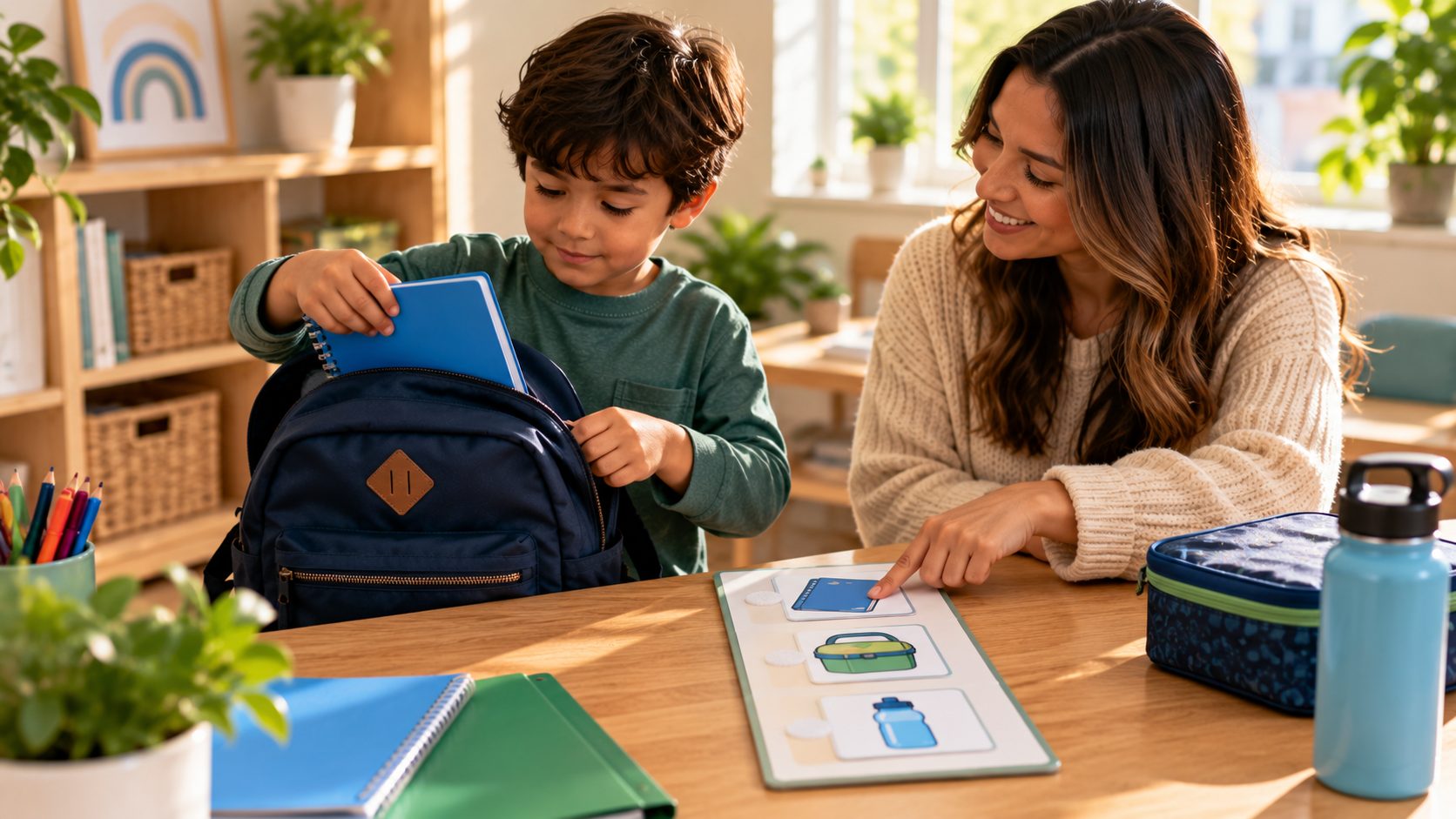
A visual checklist can remain available even after an adult stops pointing to it.
Helping without doing everything for the learner
A student knows how to place books in a backpack but often forgets which items to bring home. The educator gives a quick pointing gesture toward a checklist. The student looks, finds the missing folder, and packs it. Across later opportunities, the adult pauses instead of pointing. Eventually, the student checks the list without that reminder.
This illustrates a key distinction: the adult’s pointing gesture is an additional instructional prompt, while an accessible checklist may be a useful long-term support. A person can be independent while using a schedule, AAC device, adapted equipment, or help they direct themselves.
Same skill, different level of adult help
What is prompting in ABA?
A prompt is supplemental assistance or an added cue that increases the likelihood of a desired response during instruction. It may be a spoken hint, gesture, demonstration, physical support (with appropriate consent), or alteration to materials. A prompt is not the same as the everyday cue that should eventually guide the response.
For the backpack skill, the natural cues may include dismissal time, the items on the desk, and the student’s familiar packing checklist. The teacher’s extra point to a folder is a prompt because it is additional assistance. Whether a picture, word, or gesture functions as a prompt depends on how the task is arranged and what the learner already uses.
Natural cue and additional prompt
Different types of prompts
Prompt types include verbal (a spoken hint), gestural (pointing), model (demonstrating the response), physical (helping guide movement, when appropriate and agreed to), and visual or textual prompts (an added card or instruction). A stimulus prompt instead changes a feature of the instructional material, such as highlighting a correct sorting bin. Response prompts provide help about how to perform the response.
No single fixed ranking of “weakest to strongest” applies to every learner. A model might help one person more than spoken reminders, while another learner finds a written cue clearest. Physical prompting must never be presumed necessary or acceptable; respect motor access, consent, comfort, and safety.
Four ways to support the same sorting skill
How prompting hierarchies differ
A prompt hierarchy is a planned sequence of assistance levels selected for a particular skill and learner. It should specify what each prompt means, when a learner can respond without more help, and how an instructor responds to errors or nonresponses.
| Least-to-most | Most-to-least |
|---|---|
| Begins with an opportunity for independent responding and adds assistance as needed within the teaching sequence. | Begins with a prompt expected to help the learner succeed; assistance is then reduced systematically over opportunities. |
| Often useful for a partly learned skill with a reasonable chance of independent success. | Often useful when early success requires more structured assistance and repeated errors would impede learning. |
| Example: wait → gesture toward folder → demonstrate locating it, if needed. | Example: model placing folder → gesture toward folder → independent packing. |
Direction of assistance
Least-to-most prompting in practice
Consider a learner putting school supplies in a bag. The educator presents the natural routine cue and waits an individually appropriate interval. If the student does not begin, the adult points toward the folder. If that does not help, they may demonstrate locating the folder—if modeling is part of the selected hierarchy. The student completes the action with an appropriate level of support; the adult records the response.
The learner should not be left repeatedly confused or distressed to preserve an arbitrary “independent” trial. A responsive instructor can change the task, increase clarity, or provide the prompt that is effective and acceptable.
Illustrative least-to-most opportunity
Most-to-least prompting in practice
Most-to-least prompting starts with an effective level of help that is likely to produce correct performance. As the learner shows success, the instructor delivers less supplemental assistance under predefined criteria. For example, an educator initially models placing supplies in a labeled storage bin. Later, only a brief gesture is needed; eventually the learner uses the bin label independently.
The first prompt does not have to be physical. An accessible demonstration, a visual cue, or another individualized prompt may be the appropriate starting point.
Illustrative decrease in educator assistance
What is prompt fading?
Prompt fading is the systematic reduction or removal of supplemental cues as responding comes under the control of the intended task cues. Planning how to fade prompts from the beginning can help reduce unnecessary adult dependence.
Possible fading methods include reducing the intensity of a hint, switching from a demonstration to a gesture, increasing the interval before giving an additional prompt, gradually removing an added highlight, or simply giving the learner an opportunity to initiate. The goal is not to eliminate supports that remain useful. A calendar, checklist, wheelchair adaptation, or communication device may be part of an independent routine.
Time delay: creating an opportunity to respond
Time delay separates the instructional cue from an added prompt. In constant time delay, teaching may begin with immediate prompting and then move to a fixed, predetermined interval (such as four seconds). In progressive time delay, the interval increases systematically across teaching opportunities (for example zero, two, then four seconds). These are illustrative values, not recommendations for every learner.
The response interval should reflect the learner’s processing, motor access, communication method, and the task’s demands. Simply waiting longer without a teaching plan is not automatically an effective time-delay procedure.
Time delay examples: seconds before the extra prompt
0 s→Later
4 s→Later
4 s
What is prompt dependency?
Sometimes a learner begins waiting for the added adult cue instead of responding to the available task information. This may appear as consistently waiting for a gesture, looking to an instructor before beginning a mastered step, or difficulty starting when a particular adult is absent. In those cases, instructional prompts may be controlling more responding than intended.
Needing support is not the same as prompt dependency. The question is whether added instructional help can be reduced without removing access, safety, or useful accommodations. Rather than telling the learner to “be independent,” the team can clarify cues, wait appropriately, and collect prompt-level data.
Adult cue vs. learner-directed support
Prompting during daily living skills
Handwashing
Teach a practical task analysis and provide prompts only for the components that need them. A person may turn on water independently yet need a picture reminder about soap. If an accessible routine strip works reliably, it can stay posted near the sink.
Packing a backpack
Point to a checklist when a learner first practices the routine. Later, pause before pointing, observe whether the learner checks the list, and record the type of help needed. Avoid prompting steps already mastered.
Household chores
A learner sorting laundry might watch one demonstration, then begin using a set of visible labeled bins. Chores should be meaningful, chosen collaboratively when possible, and adapted to motor access and family context.
Household routine: visual checklist
Prompting during functional communication instruction
Prompts may help teach a new request such as “Help” or “Break” using spoken language, a gesture, or an AAC/picture response. An adult might initially model tapping a Help card, then provide an opportunity for the learner to access the card without another prompt. The response should be followed by meaningful help when feasible.
AAC systems and communication choices must remain accessible; they are not privileges to be earned. Honor spontaneous communication and refusal, and avoid teaching request forms through unnecessary distress.
Teaching a meaningful Help request
Common prompting mistakes and adjustments
- Prompting immediately: Provide an appropriate opportunity to respond first when the teaching plan calls for it.
- Repeating verbal cues: Check whether a gesture, model, accessible visual, or changed environment is clearer.
- Never fading: Define when and how assistance can be reduced before teaching begins.
- Fixed hierarchy for everyone: Select prompts around the actual learner and skill; do not assume a physical prompt is required.
- Removing useful accommodations: Fade the unnecessary additional cue, not the person's access to the task.
- Ignoring consent or discomfort: Stop and adapt physical support or other prompts that are unwanted, distressing, or unsafe.
- Tracking only completion: Record independent versus prompted performance and the actual help delivered.
How to measure prompt levels and independence
Write operational definitions of the prompt levels before collecting data. For example, I = independent after the natural task cue, G = adult gesture, M = adult model. Note whether the routine step was completed accurately and whether another factor—such as an inaccessible material—affected performance.
Look for patterns across opportunities and settings. Reduced adult prompting can be meaningful even if a visual checklist remains available.
Prompt-level observation record — hypothetical example
| Practice | Skill | Response | Adult assistance | Completed |
|---|---|---|---|---|
| Mon | Pack folder | Prompted | Model (M) | Yes |
| Tue | Pack folder | Prompted | Gesture (G) | Yes |
| Wed | Pack folder | Independent | None (I) | Yes |
| Thu | Pack folder | Independent | None (I) | Yes |
Sample prompt-fading teaching plan
Suppose a learner wants to pack a backpack with fewer adult reminders. A brief teaching plan might look like this:
Backpack packing: illustrative plan
| Plan element | Example |
|---|---|
| Meaningful target | Pack folder, lunchbox and water bottle using the accessible checklist. |
| Natural cue | End-of-day routine, school materials, established checklist. |
| Current performance | Folder and bottle placed independently; adult reminder often needed for lunchbox. |
| Planned prompt | Pause for an appropriate response interval, then gesture at lunchbox icon if needed. |
| Fading criterion | After consistent correct use of checklist across planned opportunities, withhold the gesture and monitor. |
| Response | Provide natural access to departure routine and meaningful feedback about successful organization. |
| Measurement | Each item: independent, gestural prompt, other help, or not completed. |
| Generalization | Try different packing locations and relevant caregivers/educators. |
| Accommodations | Keep accessible checklist and adapted materials; honor request for assistance. |
Related Adaptive Strides resources
Read our guides on task analysis, daily living skills, visual schedules, positive reinforcement, and functional communication.
Explore existing Visual Supports and Checklists shop categories. Product listings will appear only when available.
Frequently asked questions
What is prompting in ABA?
Additional help or a supplemental cue provided during instruction to increase the chance of a correct response.
What are the different types of prompts?
Examples include verbal, gestural, model, physical, visual/textual, and stimulus prompts. Selection depends on context.
Least-to-most versus most-to-least?
Least-to-most adds help when needed within a planned teaching sequence. Most-to-least starts with effective assistance and systematically reduces it over learning opportunities.
What is prompt fading?
A planned reduction of extra instructional assistance so natural task cues can guide the response.
What is prompt dependency?
When responding is disproportionately controlled by added prompts rather than the intended task cues; needing accommodations is not itself dependency.
How does time delay work?
It arranges an interval between the natural cue and an additional prompt. The interval may stay fixed or increase across instruction.
When should prompts be faded?
Plan fading at the outset and use learner performance, skill accuracy, and comfort to guide changes.
Can a person be independent while using a visual schedule or AAC?
Yes. Independent use of a functional support is a meaningful form of independence.
The goal is usable skill, not the absence of all support
Prompting can make an emerging skill easier to acquire; planned fading can reduce unnecessary instructor-delivered assistance and help the learner respond to meaningful everyday cues. Thoughtful instruction balances successful practice with learner choice, comfort, and accessibility.
A supportive adult may step back from pointing while a learner continues using a familiar visual schedule. That is not a failure to fade prompts—it may be exactly what meaningful independence looks like.
References and further reading
- Cooper, J. O., Heron, T. E., & Heward, W. L. (2020). Applied Behavior Analysis (3rd ed.). Pearson. Publisher information.
- National Professional Development Center on Autism Spectrum Disorders. Prompting (Least-to-Most): Steps for Implementation. Read the practice guide.
- National Professional Development Center on Autism Spectrum Disorders / AFIRM. Prompting: Evidence-Based Practice Brief Packet. Read the brief.
- Autism Internet Modules. Prompting. OCALI / NPDC. Module overview.
This article is general educational information, not an individualized treatment plan. Families and providers should adapt prompts and accessibility supports collaboratively with the learner and relevant qualified professionals.