How to Teach Independent Daily Living Skills: A Practical Guide for Parents and Educators
A practical approach to choosing meaningful everyday goals, breaking activities into teachable steps, and supporting participation with the right level of help.
By Adaptive Strides Editorial Team · October 21, 2026 · Approximately 12-minute read
Building skills for everyday life
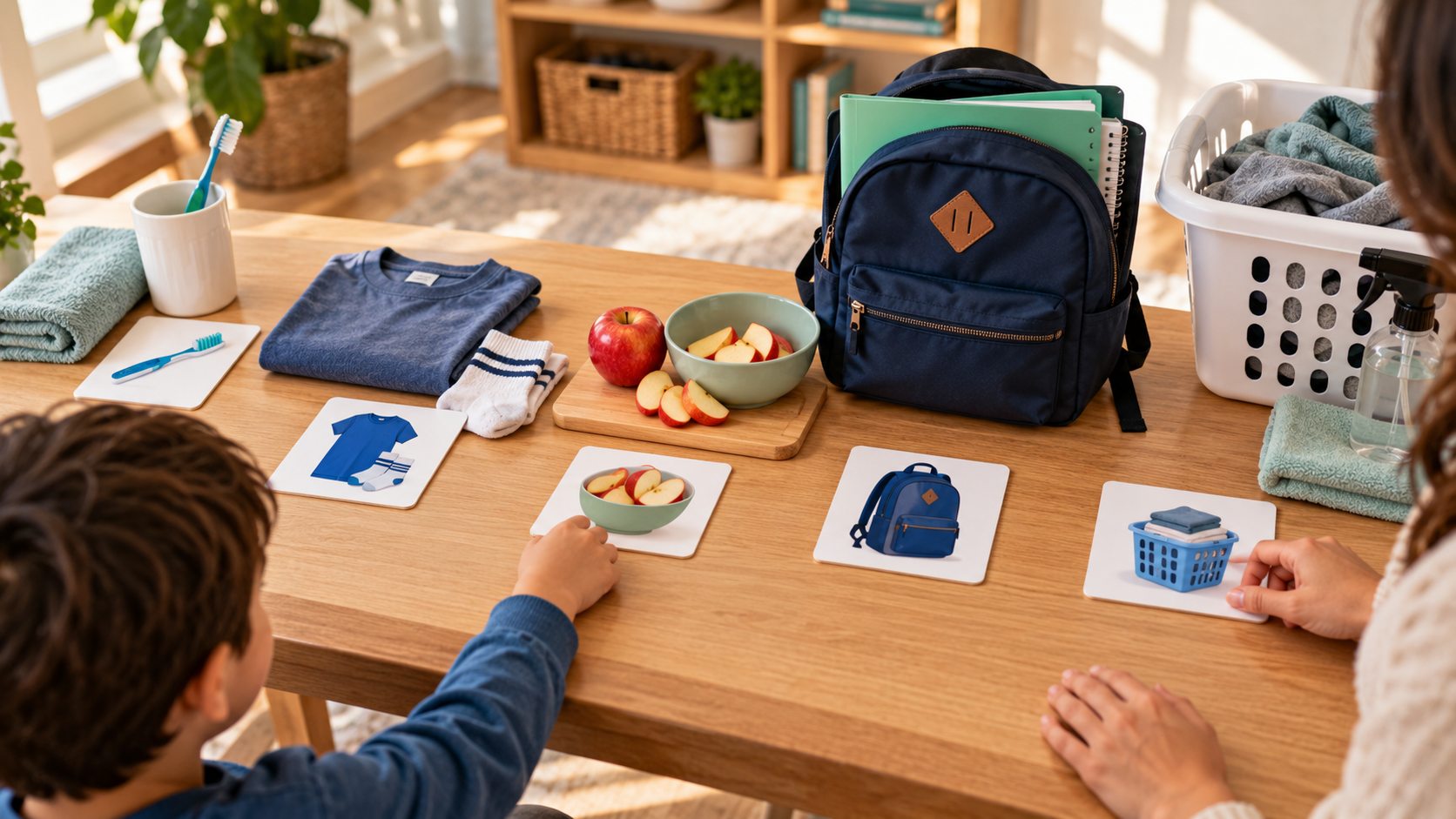
Getting dressed, washing hands, preparing a snack, organizing a backpack, and helping with household chores can look like simple activities from the outside. In practice, each one may require planning, communication, motor coordination, sequencing, and problem-solving. Someone might know what to do but have trouble beginning; another person might understand every step but need accessible tools or physical assistance.
Teaching daily living skills means identifying useful activities, understanding the person's current abilities, and creating opportunities to participate with support that fits. The goal is not doing everything alone. Making choices, directing assistance, using assistive technology, and completing parts of a routine can all represent meaningful independence.
What are adaptive daily living skills?
Adaptive behavior includes conceptual, social, and practical skills used in everyday life. Daily living skills belong primarily to the practical domain: personal care, household responsibilities, routines, community navigation, safety, and participation in everyday tasks. This article focuses on teaching those practical abilities, not on diagnosing or rating anyone's abilities.
Everyday skill areas
Each category contains many different skills; select goals based on usefulness and individual priorities.
Start with meaningful, individualized goals
Begin by asking what the learner wants to do, what would make everyday life easier, and what matters to their family or support team. A teenager might want to prepare a favorite snack, while a younger learner may want to choose clothing. An adult may want more control over a shopping trip, even if a support person continues handling transportation.
Consider existing strengths, communication, motor abilities, sensory preferences, age, culture, available supports, and environmental accessibility. Avoid choosing goals based only on what is convenient for adults. A useful goal is both functional and important to the person learning it.
Example: Choose a goal together
| Skill | Interested | Already does | Wants support |
|---|---|---|---|
| Prepare a snack | ☑ | ☐ | ☑ |
| Organize belongings | ☑ | ☑ | ☑ |
| Brush teeth | ☐ | ☑ | ☐ |
| Choose clothing | ☑ | ☑ | ☐ |
| Household chore | ☑ | ☐ | ☑ |
Illustrative worksheet, not a client record. The learner can point, speak, use AAC, or communicate preferences in another way.
Assess the current skill level before teaching
Observe the skill during a natural opportunity. What happens without extra reminders? Which steps are already independent? Which need a verbal cue, model, physical help, or an environmental adaptation? Sometimes a step is difficult not because it has not been learned, but because materials are out of reach, directions are unclear, or the environment is uncomfortable.
Keep observation brief and respectful. Write down the step and the support needed, then look for one manageable place to start. The following snack-preparation example illustrates a simple observation tool; it is not a formal assessment.
Example: Snack preparation observation
| Step | Independent | Prompted | Needs assistance |
|---|---|---|---|
| Gather plate | ✓ | ||
| Choose snack | ✓ | ||
| Open container | ✓ | ||
| Put food on plate | ✓ | ||
| Put items away | ✓ |
This example directs attention to opening the container and using fewer reminders for plating—not reteaching everything.
Break complex skills into smaller steps
A task analysis describes the individual actions that make up a larger skill. For handwashing, rather than saying only “wash your hands,” show the steps in the order they occur. A learner may need pictures or a short checklist; someone else may prefer a simple verbal reminder. Break a step into even smaller actions when it is difficult, and combine familiar steps when the detail is no longer helpful.
Hand hygiene also has a health component. Public-health guidance recommends lathering and scrubbing all hand surfaces for at least 20 seconds before rinsing, so any simplified teaching list should be accompanied by that instruction and any necessary accessibility or hygiene adaptations.
Example: Handwashing task analysis
A functional sequence with editable labels; teach thorough lathering, including backs of hands, between fingers, and under nails.
For a deeper explanation of identifying and sequencing steps, read What Is Task Analysis in ABA?
Choose a teaching approach that fits
Once the steps are clear, teaching can be organized in different ways. In forward chaining, the learner focuses on the earliest step before later steps are added. In backward chaining, the adult supports earlier steps while the learner masters the final step first. With total-task presentation, the learner has an opportunity to participate in every step during each practice.
All three are teaching arrangements, not guarantees of success. Choose based on the learner's strengths and preferences, the complexity of the skill, safety, and opportunities for successful participation. Use the least assistance necessary, allow response time, and gradually reduce unnecessary prompts when appropriate. Some learners will continue needing helpful accommodations.
One activity, three ways to teach
Four illustrative steps for putting on a jacket: find jacket → position sleeves → insert arms → close jacket.
Filled squares show teaching opportunities, not a judgment about which approach is best.
Use visual supports to promote participation
Pictures, objects, checklists, written instructions, schedules, and video models can provide information without repeated adult directions. Some learners benefit from a two-step First-Then board; others need a longer sequence. Visuals are only useful when their meaning is clear, accessible, and taught as needed. They should not turn a reasonable choice or request for help into an obligation to comply.
Same laundry routine, different levels of information
- Sort clothes
- Load washer with help
- Move clean clothes
- Fold or sort items
- Put clothing away
Both examples communicate useful information; the amount of detail depends on the learner and situation.
Explore our guides to visual schedules and First-Then boards for more examples.
Use meaningful outcomes, motivation, and choice
People are more likely to participate in activities that matter to them. Preparing a snack is a useful example: the learner chooses ingredients, assembles a simple food item, and gets to enjoy something they made. The outcome may be naturally motivating, while assistance, praise, or access to a preferred activity may also support learning depending on their effects.
In ABA, a consequence is called reinforcement only when future behavior increases under similar circumstances. A preferred item is not automatically an effective reinforcer. Respect choices, discomfort, communication, and assent; never withhold essentials such as food, water, bathroom access, or necessary support to obtain compliance.
Snack preparation: participation and natural outcomes
Illustrative sequence: provide supervision, accessible utensils, and food-safety support appropriate to the individual.
For a closer look at the principle, see What Is Positive Reinforcement in ABA?
Practice across home, school, and community settings
A skill learned in one setting may not automatically transfer elsewhere. Different sinks, utensils, backpacks, helpers, or environments can change what the learner needs. Generalization means using a skill under varied relevant conditions. Plan practice opportunities across settings while keeping safety and accessibility consistent.
At home, a learner may organize a bedroom with labeled baskets. At school, they may prepare a desk using a short checklist. In a grocery store, a simple picture list can help someone identify items, make choices, and participate in purchasing—whether or not they complete the transaction independently.
Example: A visual shopping list
A portable list can make community participation more predictable and support choice.
Address common learning challenges
If someone struggles to start, consider whether the materials are ready and the first action is clear. If steps are skipped, check whether the sequence has been taught and whether a checklist would be useful. If motor coordination or sensory discomfort creates barriers, adapt the equipment, environment, or response expectations before adding more prompts.
When participation varies across days or settings, notice fatigue, motivation, illness, environment, and differences in support. If an activity causes distress, respond to the person's communication and reconsider whether the task or teaching arrangement needs adjustment. More practice is not always the solution.
Bedroom cleanup: two levels of detail
- Clothes into basket
- Toys into bin
- Clear the bed
- Find dirty clothes
- Place clothes in basket
- Collect floor toys
- Put toys into bin
- Move books to shelf
- Clear bed surface
Both describe the same general routine; neither is universally better. Choose the amount of detail that supports understanding.
Measure meaningful progress
Progress can mean independently completing more steps, asking for help at the right moment, using a schedule without a verbal reminder, or directing a support person. Tracking can be as simple as marking whether each step was independent or prompted, and noting whether the person was comfortable and engaged.
Collect only information that helps make teaching decisions. Avoid judging success solely by speed, adult convenience, or the total number of tasks finished.
Weekly progress tracker — illustrative example
| Skill step | Mon | Tue | Wed | Thu | Fri |
|---|---|---|---|---|---|
| Find backpack | I | I | I | I | I |
| Add folder | P | P | I | I | I |
| Add lunch | P | P | P | I | I |
| Close zipper | I | I | I | I | I |
I = independent; P = prompted. Fictional values only; prompt type, participation, and context can be noted when useful.
A simple daily living skills teaching plan
Here is a sample plan for organizing a backpack. This is a starting framework, not a personalized intervention or safety plan. It can be adapted to other skills by changing the steps, supports, and observation method.
| Target skill | Pack backpack for school |
|---|---|
| Component steps | Find bag; place folder; add lunch; zip bag; place by door |
| Teaching approach | Practice the full sequence with prompts as needed; fade unnecessary cues |
| Visual support | Five-item checklist beside the backpack station |
| Meaningful outcome | Ready for the day; self-checking and positive feedback that matters to learner |
| Progress measure | Independent or prompted completion per step and ability to request help |
| Adaptations | Accessible storage, larger zipper pull, fewer steps, AAC or support person as needed |
Frequently asked questions
What are examples of adaptive daily living skills?
Examples include personal hygiene, dressing, food preparation, laundry, organizing belongings, using shopping lists, and participating safely in community activities.
How do you teach daily living skills step by step?
Choose a useful skill, observe what the learner already does, break the activity into actions, select accessible teaching supports, practice consistently, and adjust based on participation and progress.
What is the difference between adaptive skills and independent living skills?
Adaptive skills cover conceptual, social, and practical abilities for everyday functioning. Independent living skills commonly refers to practical activities and self-direction involved in daily life. The terms overlap.
How can visual supports help?
They can show what comes next, reduce the need for repeated spoken directions, and clarify individual steps. The format must be understandable and useful to the learner.
How do you know when a daily living skill has been mastered?
Use an individualized criterion that includes the desired performance, necessary support, relevant settings, and whether the skill is useful over time. No single mastery rule fits every learner.
Can teenagers and adults benefit?
Yes. Daily living instruction can support people of any age, including those developing new roles, living arrangements, and community responsibilities.
What if someone needs ongoing physical assistance?
Ongoing assistance does not erase meaningful participation. Goals can focus on choice, communication, directing support, use of adaptive equipment, and completing available steps safely.
Conclusion
Teaching daily living skills works best when the goals are personally meaningful, the steps are clear, and the environment allows someone to participate. Task analysis, visual supports, appropriate prompting, and thoughtful progress checks are tools—not ends in themselves. The aim is greater access, autonomy, comfort, and functional involvement in everyday life, with the supports each person needs.
References and further reading
- American Association on Intellectual and Developmental Disabilities (AAIDD). Adaptive Behavior. Background on conceptual, social, and practical adaptive skills.
- Sam, A. (2016). Task Analysis (TA): Evidence-Based Practice Brief Packet. National Professional Development Center on Autism Spectrum Disorders.
- Centers for Disease Control and Prevention. About Handwashing. Handwashing steps and the 20-second scrubbing recommendation.
- Autism Speaks Evidence-Based Practices. Visual Supports. An introduction to visual supports and their use.
General educational information, not individualized clinical, medical, or occupational therapy advice. Adapt examples to the learner's communication, safety, and accessibility needs.