Teaching Functional Communication Skills: Helping Children Express Their Needs
Practical ways to recognize, honor, and teach meaningful communication through speech, gestures, pictures, and AAC.
By Adaptive Strides Editorial Team · October 21, 2026 · Approximately 11-minute read
Communication is more than words
Imagine a child trying to complete a difficult activity. The child looks toward an adult, points to the materials, pushes an object away, or vocalizes. These actions may communicate something important—but the adult still needs to notice the context, respond respectfully, and help the child access reliable ways to express needs.
Functional communication is not limited to speaking. People communicate using words, gestures, signs, writing, picture cards, devices, facial expression, and movement. A non-speaking person is still a communicator. The goal is not to require everyone to sound alike; it is to make communication accessible, effective, and meaningful.
What is functional communication?
Functional communication is the use of communication to accomplish a meaningful purpose: asking for help, sharing information, declining something, requesting a break, making a choice, asking a question, expressing discomfort, or connecting with another person. The form can differ while the message serves the same purpose.
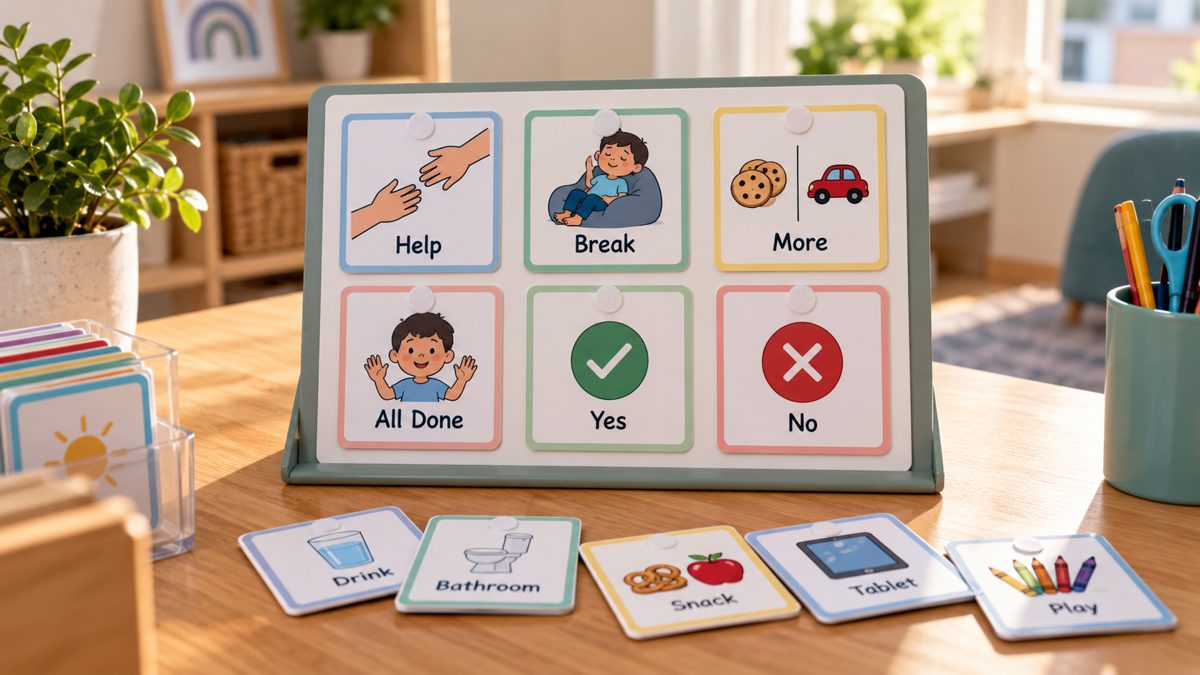
For example, one learner may say “help,” another may sign it, and another may select a Help symbol on a speech-generating device. Each can be an effective request if communication partners understand and respond. Functional communication also includes social comments, disagreement, and self-advocacy; it should not be reduced to asking for food or toys.
What might someone need to communicate?
These are example messages, not a complete communication vocabulary.
Different forms of communication and AAC
Many learners use multiple methods throughout the day: speech, gestures, body movement, sign language, handwriting, pictures, eye gaze, or technology. Augmentative and alternative communication (AAC) includes approaches that supplement or provide alternatives to spoken communication. It can include paper communication boards as well as speech-generating devices. AAC should remain available across settings; it is a communication tool, not a reward to be taken away.
Choosing a system requires attention to motor access, visual and language needs, vocabulary, the learner’s preferences, and the communication partners who will support it. Robust systems may offer far more than six buttons. Speech-language pathologists and the learner's wider support team can assist with individualized assessment and access. ASHA describes AAC as supporting functional communication across everyday contexts, using more than one communication modality when helpful.
Different methods, equal opportunity to communicate
“Can I have help?”
Pointing, signing, or indicating a choice.
Touching a clearly recognizable symbol.
Selecting a message that the device speaks aloud.
The appropriate method is whichever enables meaningful communication for that individual and situation.
Recognizing communication attempts
When someone reaches for a cup, moves away from a noisy room, or puts materials aside, an adult can attend to the context and check what the person needs. These responses do not automatically prove a specific intention or behavioral function. Rather than guessing, offer accessible options and listen to the answer. If the learner clearly says or indicates “no,” treat that message as meaningful.
Communication support is a two-way responsibility. Adults can pause, ask a simple question, offer a visual choice when appropriate, and reduce distractions. They should allow enough processing time instead of filling every silence with repeated prompts. The aim is to build trust in communication, not to make every moment a test.
Functional communication versus Functional Communication Training
The broad concept of functional communication is different from the structured ABA intervention called Functional Communication Training (FCT). FCT teaches a communicative response that accesses the same type of consequence maintaining a behavior of concern. Planning generally involves assessing what maintains the behavior, teaching an accessible alternative response, arranging the relevant consequence for that response, and supporting maintenance and generalization. Foundational work by Carr and Durand (1985) demonstrated a function-based communication approach in a small study; this does not mean one intervention fits every learner.
For example, when an appropriately assessed behavior is maintained by escaping difficult tasks, a learner might be taught a reliable way to request a break, and that request is honored. Access to a break can involve negative reinforcement, because the demand is temporarily removed. Other behavior functions require other responses and arrangements. Assessment and significant behavior interventions should be designed and overseen by qualified professionals.
Illustrative FCT sequence: a break request
The learner encounters a challenging activity.
The learner uses speech, a card, or AAC.
The adult pauses the demand and makes the break accessible.
This example illustrates one possible function-based arrangement. It is not a universal procedure.
How to teach a functional communication skill
For everyday communication teaching, caregivers and educators can use the following framework. Unlike individualized FCT for significant behavior concerns, this example does not require intentionally creating a difficult situation.
Modeling a Help request
Matching pieces are difficult to connect. A Help card is within reach.
The learner indicates “Help.” The educator provides the requested assistance, without requiring speech first.
Teaching requests for help
Help requests are valuable during puzzles, dressing, learning tasks, organizing materials, and community activities. Start by ensuring the task is accessible, then model “help” in a way the learner can use. Respond with real help; saying “good asking” while leaving the learner without assistance does not teach the intended usefulness of communication.
A learner may also communicate difficulty by handing an item to an adult. That existing gesture can be honored while introducing an additional tool, if desired. As the skill develops, practice with different adults, materials, and locations while continuing to respond to requests.
Teaching break requests, refusal, and choice
“Break,” “stop,” “no,” “all done,” “too loud,” “more time,” and “different activity” can all be important forms of self-advocacy. A communication system should give learners ways to refuse or modify activities—not just ask for favored things. Adults should honor clear communication when possible and explain unavoidable safety constraints respectfully.
A learner who requests quieter surroundings may need an environmental change, not simply praise. An AAC device or choice board should remain available even during frustration. Adults can support communication without requiring someone to appear calm before their request counts.
Example: support and self-advocacy board
Help
Break
Stop
More time
Quiet space
All done
A real communication system should match the learner's established vocabulary, sensory, language, and access needs.
Communication during home routines
At mealtimes, messages might include “more,” “finished,” “different,” or “drink.” During play, communication can involve “my turn,” “help,” “look,” or choosing an activity. Getting dressed may invite “this shirt,” “too scratchy,” or “help with the zipper.” While tidying up, a learner may express “I don't understand” or ask what comes next.
Keep communication materials available without making every request a formal learning trial. A simple picture board near snack supplies can provide access to several meaningful messages while ordinary family interaction continues.
Example: snack-time communication choices
More
Help
Finished
Different
Drink
Like it!
Communication in the classroom
School communication involves academic participation, asking questions, commenting to peers, disagreeing, seeking help, and communicating discomfort. Learners should have access to communication devices and low-tech backups throughout classes, transitions, and social opportunities—not only during challenging behavior.
Teachers can model a communication symbol during classroom activities, wait for the learner to process, and respond to the message naturally. Communication partners should learn where vocabulary is located on the student's established system rather than replacing it with an oversimplified board without consultation.
Common mistakes and helpful adjustments
- Only accepting speech: Honor gestures, signs, typing, pictures, and AAC, too.
- Teaching only requesting: Include commenting, refusing, asking questions, and expressing preferences.
- Inaccessible picture cards: Check recognition, motor reach, size, vocabulary, and placement.
- Providing a card without responding: Help learners experience that communication changes interactions meaningfully.
- Removing AAC: Maintain access even during transitions or distress.
- Excessive prompting: Pause and allow time for communication; support independence gently.
- Assuming generalization: Practice messages with different partners and settings.
Tracking meaningful communication progress
Progress is broader than fewer behaviors of concern. Consider the variety of messages used, independent and supported responses, new partners and settings, whether adults honored requests, and the learner's own satisfaction. Count independent Help requests if frequency answers your question; record opportunities when a percentage is more appropriate. Keep collection manageable and respectful.
Illustrative communication observation sheet
| Situation | Message | Support | Adult response |
|---|---|---|---|
| Puzzle | Help | Independent | Assistance given |
| Reading | Break | Modeled | Break provided |
| Snack | Different | Independent | Choice offered |
Fictional examples, not client data. Track date, location, partner, and learner feedback when relevant.
Communication and emotional regulation
Communicating “too loud,” “I need space,” “help,” or “I don't like that” may allow a learner to access useful support during a difficult moment. Functional communication is one part of emotional regulation, not a replacement for co-regulation, sensory accommodations, or safe and supportive environments. Explore our guide to emotional regulation through visual supports for related strategies.
Sample functional communication teaching plan
Goal: Request help during an independent activity
| Existing communication | Points to materials or hands an object to an adult. |
|---|---|
| Target message | Accessible Help response, alongside existing gestures. |
| Support | Help card or established AAC system visible and within reach. |
| Practice opportunity | Normal moments when the learner seeks assistance. |
| Adult response | Provide meaningful help promptly. |
| Generalization | Try across schoolwork, toys, dressing, and other partners. |
| Progress | Note independent requests, successful assistance, and learner feedback. |
Illustrative educational plan only; individualized AAC or FCT planning may require qualified professionals.
Related Adaptive Strides resources
Explore existing Visual Supports and Task Cards shop categories. No specific products are advertised until available.
Frequently asked questions
What are examples of functional communication?
Asking for help, refusing, choosing, requesting breaks, commenting, and sharing information through any accessible communication method.
How is functional communication different from FCT?
Functional communication describes meaningful self-expression. FCT is a specific, function-based ABA intervention that teaches a communicative response to access the consequence maintaining a behavior of concern.
Can non-speaking children learn functional communication?
Yes. Communication can use gestures, sign, picture symbols, writing, and AAC, whether or not speech is present.
How can families support communication at home?
Notice and honor existing attempts, keep communication supports available, model messages naturally, and respond meaningfully.
What is AAC?
Augmentative and alternative communication includes tools and methods that supplement speech or offer other means of communication, from paper boards to speech-generating devices.
How can I teach help and break requests?
Choose an accessible response, model it in natural settings, allow processing time, and respond to requests. Significant behavior concerns warrant individualized professional planning.
Can teenagers and adults benefit?
Absolutely. Meaningful communication support can be important at any age. Materials should be age respectful and tailored to the person's preferences and needs.
How do you measure progress?
Observe independent and supported messages, different settings and partners, communication variety, whether requests are honored, and learner-reported usefulness.
Conclusion: communication access creates opportunities
Teaching functional communication begins with listening. A message can be spoken, signed, indicated, typed, or selected on a device; its value comes from helping someone express themselves and be understood. Start with meaningful needs, make tools accessible, model naturally, and respond to communication with respect. The wider goal is self-expression, choice, relationships, participation, and self-advocacy—not forced speech or compliance.
References and further reading
- Carr, E. G., & Durand, V. M. (1985). Reducing behavior problems through functional communication training. Journal of Applied Behavior Analysis, 18(2), 111–126.
- American Speech-Language-Hearing Association. Augmentative and Alternative Communication (AAC): Practice Portal.
- American Speech-Language-Hearing Association. Communication Access.
This article offers general education. AAC system selection, significant communication challenges, and function-based interventions may benefit from individualized evaluation by speech-language pathologists, behavior analysts, and other qualified professionals.