
Teaching Emotional Regulation Through Visual Supports: A Practical Guide for Parents and Educators
Practical ways to help learners notice feelings, communicate needs, and access support—without treating emotions as behaviors that must be suppressed.
By Adaptive Strides Editorial Team · October 21, 2026 · Approximately 11-minute read
When feelings are hard to put into words
A family planned to go to the playground, but rain changes the afternoon. A child who was expecting the outing looks distressed and cannot easily explain what is wrong. An adult might wonder whether the difficulty is disappointment, uncertainty, noise, tiredness, or something else. Rather than guessing, a visual board could help the child show that the change is upsetting, request more information, or choose a different activity.
Emotional awareness, communicating needs, and regulating emotional responses are connected skills—but they are not identical. Some learners find visual information more accessible than a long verbal explanation. Others prefer spoken language, gestures, sign, or an augmentative and alternative communication (AAC) system. There is no single right tool for everyone.
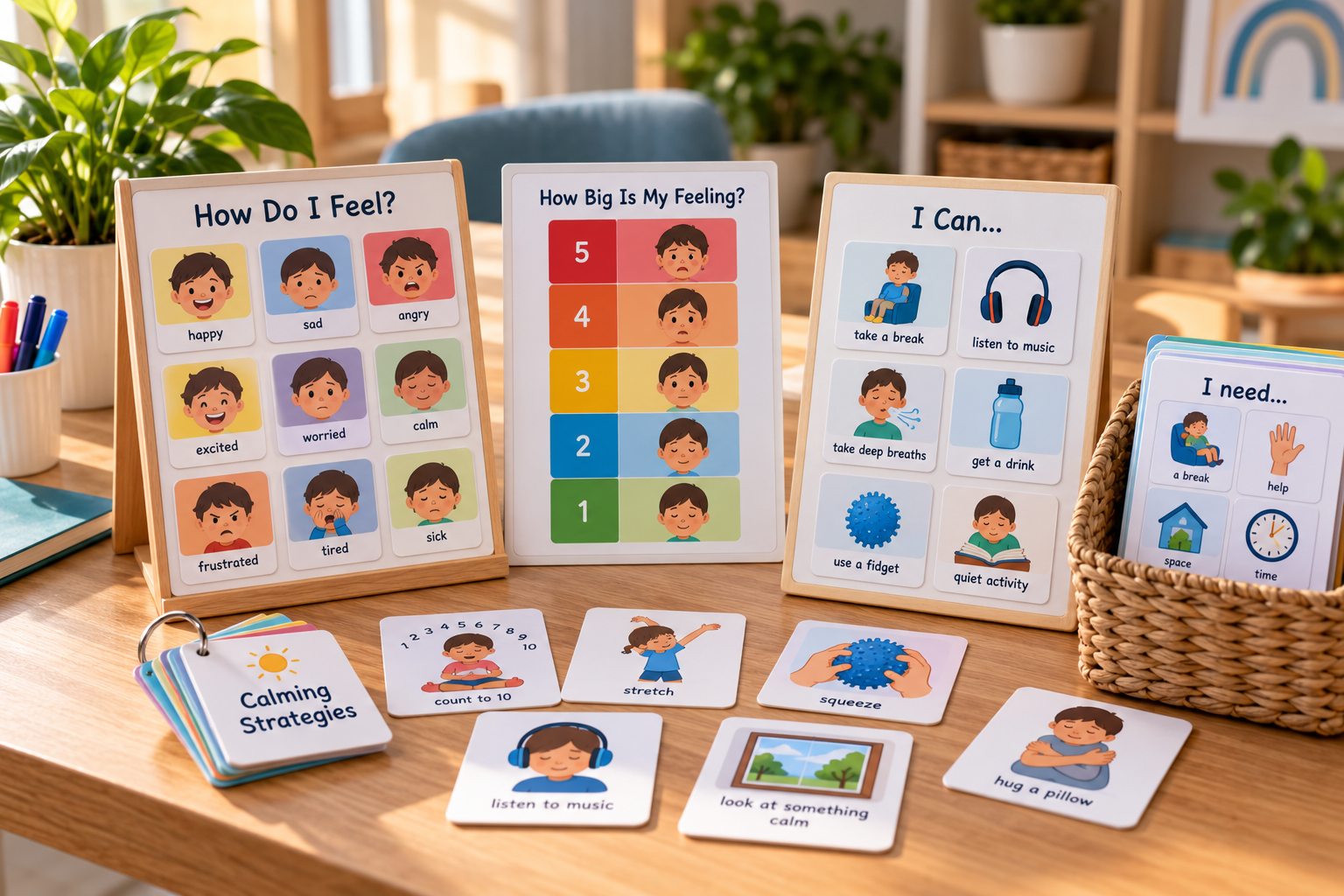
An example collection of emotional learning tools. The illustrated choices are examples—not a required program or a diagnostic test.
What is emotional regulation?
Emotional regulation involves processes that shape how we experience, respond to, and work with emotions in different situations. Regulation does not mean never feeling upset, never crying, or remaining quiet for someone else’s convenience. A person may be regulating effectively while asking to leave a loud room, speaking up about a problem, or receiving help from a trusted adult.
Emotional awareness involves noticing a feeling or internal cue. Communication involves expressing an experience or need. Regulation involves finding or accessing a response that fits the situation. These elements can happen in different orders or overlap. Co-regulation describes supportive help from another person—such as listening, reducing stimulation, offering choices, or staying nearby without pressure.
An example pathway—not a fixed rule
How visual supports may help
Emotion words and internal experiences can be abstract. A concrete card or visual menu can make possible labels, requests, or supports easier to find and remember. Tools may support a check-in, provide communication alternatives, or remind someone of previously practiced strategies. They do not replace respectful conversation, a safe environment, or an individualized communication system. Visuals should be offered, not forced.
Example feelings identification board
Teaching emotional identification
Begin with a small, useful selection of emotion words. Introduce them with pictures, stories, or familiar experiences during comfortable moments—not during a crisis. A learner might match an illustrated situation to words such as happy, sad, or frustrated, then explain or select a different word if the first choice does not fit.
Over time, expand vocabulary to include uncomfortable, uncertain, relieved, overwhelmed, proud, or disappointed as appropriate. Provide opportunities for self-report, but do not tell a learner they must be angry because their face looks tense. Respect “I don’t know,” and consider options such as “something feels wrong” when a precise label is unavailable.
Example matching activity
Offer emotion-word cards separately and discuss more than one possible response. Different people can feel differently about the same event.
Recognizing body signals without guessing feelings
Interoception refers broadly to sensing what is happening inside the body. People may notice a quicker heartbeat, tense shoulders, warm skin, a busy stomach, changed breathing, or low energy. A neutral body-awareness worksheet can invite a learner to point to or describe a sensation without assigning it a fixed emotion.
Physical sensations can also reflect illness, hunger, pain, exercise, or sensory conditions. Listen carefully and investigate possible discomfort rather than assuming that every sensation is emotional.
What do you notice in your body?
Using feelings scales or emotion thermometers
Some learners benefit from a scale that communicates how intense or uncomfortable an experience feels. Start by exploring what each number means to that person. A five-point scale may help a learner ask for support earlier or explain a change in comfort. The scale is not an objective way for adults to rate someone else’s internal experience, and nobody must begin at level one or progress through every level.
Example self-reported comfort scale
Communication comes before compliance
During a difficult moment, a functional request can be more useful than expecting someone to independently remember a new calming strategy. Spoken words, gestures, AAC, and picture cards can all communicate needs. Make requested help available when feasible; acknowledge communication even when an immediate request cannot be met exactly.
Example: “What do you need?” board
Teaching individualized coping and support choices
Explore regulation strategies during calm, low-pressure times. Quiet space, music, movement, a sensory object, a pause, a conversation, or an environmental change may be useful. Deep breathing or counting can help some people and feel uncomfortable or ineffective to others. Offer choice and revisit whether a strategy actually helps the person.
Support choices the learner can select
Co-regulation: what adults can do
When someone is overwhelmed, the priority may be safety, comfort, and communication rather than completing the original task. An adult can lower their voice, reduce demands, allow physical space, offer an accessible way to ask for help, and adjust noise, lighting, or the activity. They can remain available without insisting on conversation or eye contact.
Supported regulation is not failure. Some people will continue to need or prefer assistance, and that support may make broader participation possible.
Three examples at home, school, and in the community
At home: plans change
When a playground trip is canceled, update the plan visually and offer meaningful alternatives without pretending they are the same as the lost activity. A child might choose indoor play or art, or express disappointment and choose neither right away.
Change of plans
At school: asking for a break
A learner encounters a hard assignment. A small break card or AAC button lets the student request time to regroup. The teacher honors the request, checks whether the task needs adaptation, and later collaborates on the next step. The goal is usable communication, not simply silent task completion.
In the community: too much noise
At a busy shop, the person points to “quiet space” or “leave.” The caregiver responds by finding a quieter area or leaving when possible. Sensory discomfort is a meaningful access need, not automatically misbehavior.
Common mistakes and useful adjustments
Assuming an expression reveals the emotion: ask rather than label someone else’s feelings. Too many choices: offer two or three familiar options. Teaching only during distress: practice strategies when the person is comfortable. Demanding calm before listening: respond to communication right away. Using a feelings scale to judge the learner: let the learner describe their own intensity. Ignoring the environment: address sensory, physical, communication, and relationship factors as well as teaching skills.
Measuring progress in meaningful ways
Look beyond whether someone appears calm. Helpful indicators may include more successful help requests, identifying personally meaningful cues, choosing a preferred support, accessing accommodations, participating more comfortably, or expressing greater satisfaction. Record only information needed to make teaching and environments better.
Simple weekly observation example
| Situation | Communication | Support offered | Response / next adjustment |
|---|---|---|---|
| Unexpected schedule change | Pointed to “more time” | Extra transition time | Reported ready after pause |
| Noisy classroom | Selected “quiet space” | Quieter area | Asked to return later |
Sample emotional regulation teaching plan
| Meaningful goal | Communicate discomfort and access support during difficult activities. |
|---|---|
| Current communication | Speech, gesture, or AAC as preferred. |
| Visual support | Small choice board: help, break, more time, quiet space. |
| Teaching opportunities | Low-pressure practice, then real-life opportunities with adult responsiveness. |
| Adult response | Acknowledge and provide feasible requested support. |
| Accommodations | Adapt tasks, sensory conditions, pacing, or access methods. |
| Meaningful progress | Communication access, learner comfort, effective support, and participation. |
Illustrative educational example; not an individualized clinical treatment plan.
Related Adaptive Strides resources
Explore the existing Visual Supports and Checklists shop categories. Individual products will be linked when available.
Continue learning: Visual Schedules, First-Then Boards, Positive Reinforcement, and Daily Living Skills.
Frequently asked questions
What are visual supports for emotional regulation?
Pictures, scales, or communication options that help someone identify an experience, make a request, or find a preferred support.
How can I teach emotion identification?
Use a few familiar words, relevant examples, and opportunities for self-report, while avoiding assumptions about facial expressions.
How is regulation different from suppression?
Regulation supports managing emotions in ways that meet needs. Suppression focuses on hiding emotional expression, which is not the goal of these supports.
What if a learner does not benefit from an emotion thermometer?
Try words, pictures, body-awareness language, AAC, or direct requests for support. A scale is optional.
Can teenagers and adults use visual supports?
Yes, when the format is age-respectful and personally useful. It may be a phone-based choice menu or a written list rather than cartoon cards.
What is co-regulation?
Responsive assistance from a trusted person, including emotional connection and environmental adjustments, that helps someone access support during difficult moments.
Conclusion: support communication, not emotional silence
Visual tools may help make feelings, support choices, and changes in routine easier to understand. The best starting point is a meaningful goal identified with the learner, followed by simple accessible materials, thoughtful practice, and a willingness to adjust. Comfort, self-advocacy, trusted relationships, and meaningful participation matter more than looking calm on demand.
Significant or persistent distress may warrant additional individualized support from qualified professionals; general educational resources are not a substitute for that care.
References and further reading
- Gross, J. J. (1998). The Emerging Field of Emotion Regulation: An Integrative Review. Review of General Psychology, 2(3), 271–299.
- National Center for Pyramid Model Innovations. Practical Strategies: Emotional Literacy, Behavior Regulation, and Visual Supports. Educational guidance and materials for families and educators.
General educational information only. Personalize communication and support options with the learner and their trusted team.