How to Teach Social Skills Through Natural Everyday Interactions
Everyday play, conversations, and shared routines can create opportunities to build meaningful social communication—with the learner's interests, choices, and comfort at the center.
By Adaptive Strides Editorial Team · Educational guide · October 21, 2026
Social skills happen throughout the day
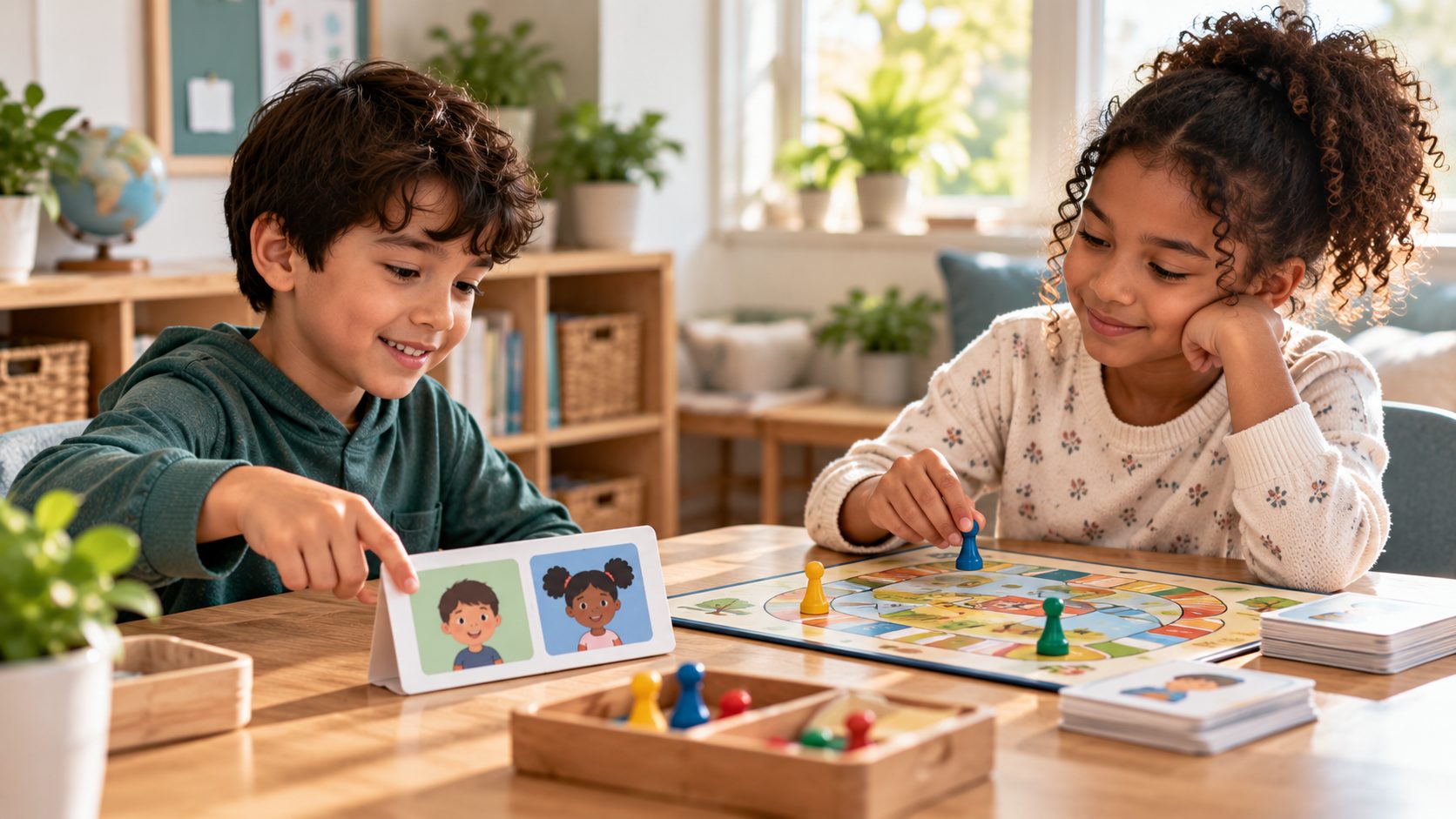
Two children are playing a board game. One wants a turn while the other is deciding what to do next. They might point to the game, ask a question, use a turn card, or suggest a different rule. These ordinary moments can offer opportunities to practice communication, patience, negotiation, and responding to another person's ideas.
Social learning does not have to happen only during formal lessons. It can grow from activities that people already enjoy together. The goal is not to make everyone interact in the same way. It is to support communication, relationships, choice, and comfortable participation.
What are social skills?
Social skills are communication abilities and behaviors that help people interact meaningfully with others. They may include initiating an interaction, responding to someone, asking questions, sharing an interest, taking turns, negotiating disagreements, and communicating boundaries.
Social participation also includes saying no, requesting clarification, choosing not to join an activity, or asking for space. These are useful skills—not social failures. Communication might involve speech, gestures, sign language, typing, pictures, or augmentative and alternative communication (AAC). The most useful method is one that is accessible and meaningful to the learner. Research and guidance describe multiple valid communication modes.
Why natural interactions matter
In Natural Environment Teaching (NET), teaching opportunities are intentionally embedded within meaningful everyday activities. A learner interested in building blocks might practice requesting a specific piece while creating something together. The adult responds naturally by sharing a block, asking a genuine question, or joining the activity.
Research identifies naturalistic interventions and peer-based approaches among established practices for supporting certain autism-related learning goals, although outcomes vary and a skill practiced in one setting may not automatically carry over everywhere. Not every conversation or game is a formal NET procedure, and not every interaction needs to become a lesson. See references.
Five practical ways to support social skills
1. Follow the learner's interests
Start with something the learner already enjoys. If they love construction toys, join the building project instead of immediately directing them toward a new activity. Offer materials, notice their ideas, and allow them to lead.
2. Model communication naturally
Show useful ways to interact without demanding imitation. During a game, model “Can I have a turn?” or demonstrate the equivalent AAC message. Keep communication tools available throughout the activity.
3. Create real choices
Offer meaningful options, such as playing a group game, drawing together, or taking a break. Honor the choice when feasible. Choosing not to interact right now can be an appropriate way to communicate a need.
4. Support turn-taking and shared activities
Games, art, cooking, or cooperative tasks can help partners coordinate actions. Some learners benefit from a movable turn marker; others manage turns through speech or gestures. Use the support only when it is helpful.
5. Recognize and respond to communication
When someone asks a question, expresses a preference, says no, or shares an idea, respond meaningfully. Being heard is itself an important part of a successful interaction. Avoid making access to ordinary communication dependent on a perfect phrase.
Teaching conversation skills
Conversation involves more than a series of memorized questions. It can include starting a topic, asking a relevant question, responding to a partner's interest, sharing new information, seeking clarification, and ending or changing a conversation comfortably.
Imagine two classmates discussing a favorite video game. One describes a level they enjoy. The other responds by sharing a favorite character or asking what happens next. An adult can model a possible response, then allow the conversation to develop without constant correction.
For learners who want a reminder, a small optional prompt card may help. It should support natural exchange—not become a compulsory script.
At home, school, and in the community
At home: A shared recipe can create opportunities to choose ingredients, ask for a turn mixing, and negotiate whose task comes next. Family games and hobbies can work similarly.
At school: Cooperative art and class projects offer opportunities to share materials, contribute ideas, ask for clarification, or communicate that a task is uncomfortable. Teachers can prepare peers to respond respectfully to AAC and different communication styles.
In the community: A person might ask a store employee where an item is located, select an activity at a recreation center, or tell a group they would prefer to observe. Choose settings and interaction opportunities that are comfortable and accessible for the individual.
Common mistakes to avoid
Social instruction can become counterproductive when adults insist on eye contact, require participation during discomfort, repeatedly prompt every sentence, or correct harmless differences in tone and body language. Some people need extra processing time, alternative communication methods, or a quieter setting.
A more respectful approach is to ask what the learner wants from social interaction, make communication supports available, and consider the experience of everyone involved. A friendship cannot be guaranteed by teaching particular phrases; mutual interest and consent matter too.
Related Adaptive Strides resources
Continue learning with existing educational articles. Printable shop resources can be explored when available; no specific product is required to try these ideas.
Frequently asked questions
Conclusion
Social skills can be supported through ordinary moments of connection: playing, sharing ideas, asking questions, and negotiating choices. Follow the learner's interests, model accessible communication, respond meaningfully, and allow genuine preferences to guide participation. A useful strategy builds communication and opportunity without turning every interaction into a test. Explore the Adaptive Strides Learning Hub for more practical guides.
References and further reading
- Steinbrenner, J. R., et al. (2020). Evidence-Based Practices for Children, Youth, and Young Adults with Autism: Third Generation Review. Journal of Autism and Developmental Disorders.
- American Speech-Language-Hearing Association. Augmentative and Alternative Communication (AAC).
- Sandbank, M., et al. (2020/2021). Understanding the Effects of Naturalistic Developmental Behavioral Interventions: A Project AIM Meta-analysis.
This is general educational information, not an individualized treatment plan. Social goals and supports should be selected collaboratively.