
How to Help Children Handle Changes in Routine: Building Flexibility and Coping Skills
Practical ways to make unexpected changes clearer, support communication, and offer meaningful alternatives at home and school.
By Adaptive Strides Editorial Team · October 21, 2026 · Approximately 7-minute read
When plans suddenly change
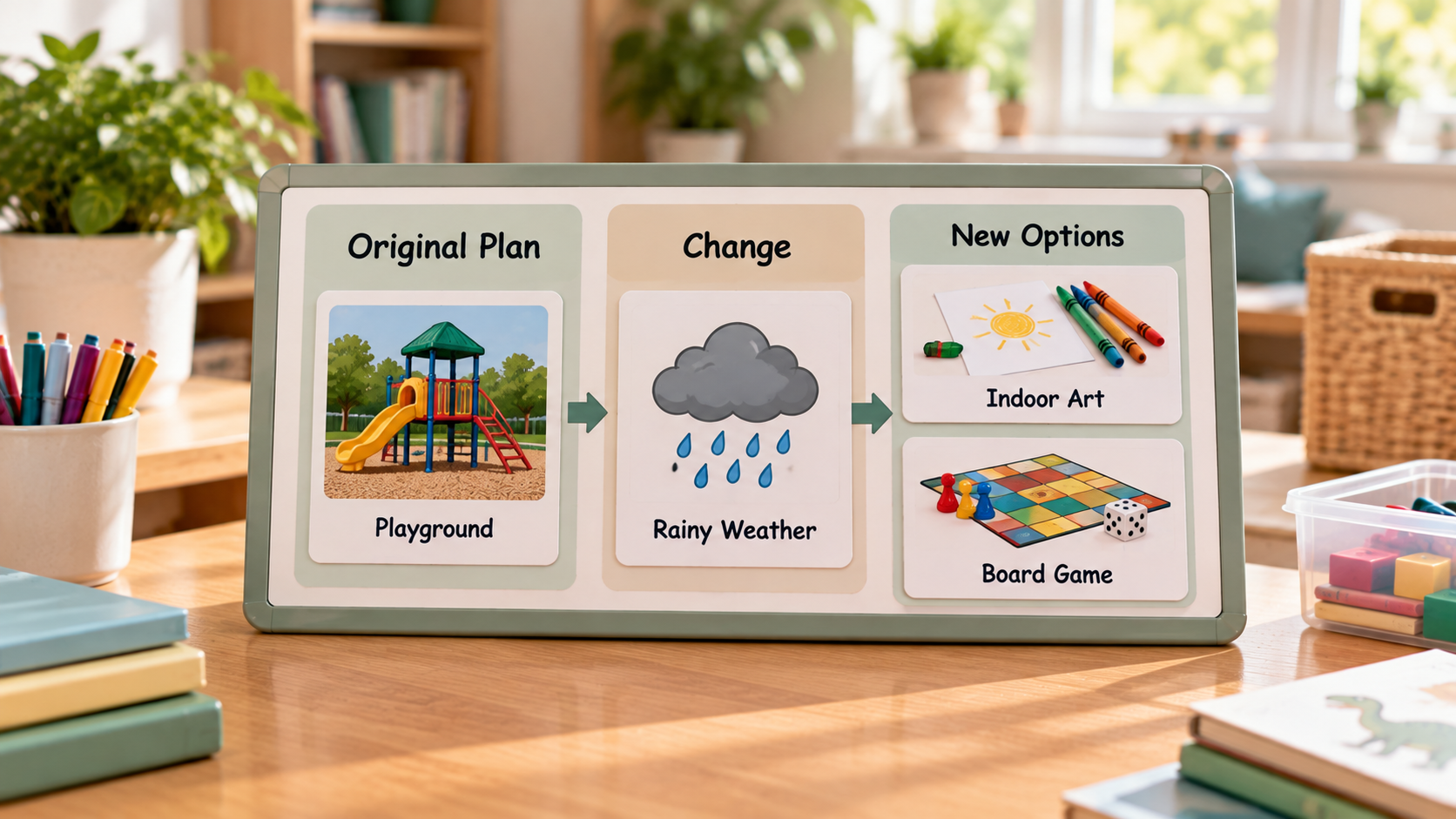
A child looks forward to visiting the playground after school. Then heavy rain begins, and the outing is canceled. What seemed like a simple change to an adult may bring disappointment, confusion, or uncertainty for the child. Familiar routines often help people anticipate what comes next; when expectations shift, some learners need more information, time, or support. Helping children with changes in routine is not about making disappointment disappear. It is about explaining what changed, recognizing feelings, and finding a workable next step together. Visual information and genuine choices can make that process more understandable.
Why changes in routine can be challenging
Changes may create uncertainty about why plans shifted, what comes next, or whether a favorite activity will happen another day. Sensory conditions, communication needs, fatigue, physical access, and past experiences also matter. A noisy indoor game may not be a comfortable replacement for quiet outdoor time.
These experiences are not unique to autism. Rather than assuming defiance, identify missing information, accommodations, or choices.
What do cognitive and behavioral flexibility mean?
Cognitive flexibility is an executive-function skill involving shifts in thinking or perspective when circumstances change. Behavioral flexibility can describe adjusting what one does when an earlier response or plan is no longer useful. The concepts are related but not identical. A child might understand that rain prevents outdoor play while still feeling disappointed or needing time to choose another activity. Flexibility can include asking questions, considering alternatives, or requesting support; it does not require appearing happy about every change. Adults should distinguish unavoidable changes from unnecessary unpredictability that could have been prevented.
Five strategies for supporting changes in routine
1. Communicate the change clearly
State what was expected and what is different: “We planned to go to the playground. It is raining heavily, so the playground trip cannot happen today.” Use speech, writing, pictures, objects, or AAC according to the learner's communication needs. Avoid vague statements such as “Plans changed” without further information.
2. Explain what happens next
Update a familiar visual schedule or Now–Next board. Show where the new activity fits, what stays the same, and whether the original plan might be rescheduled. Clear information is often more useful than repeated reassurance that everything is fine.
3. Acknowledge emotions and preferences
It is reasonable to feel disappointed when an anticipated activity is unavailable. Adults can name and accept that feeling without demanding an immediate calm appearance: “You really wanted the playground. This is disappointing.” Then ask whether the learner wants information, company, space, or another form of support.
4. Offer meaningful alternatives
Offer only options that are genuinely possible. A child might choose drawing or a board game, suggest another indoor activity, or decide to take a short break first. Choice supports autonomy when the adult can honor the selection and when declining an option is also understood.
5. Provide time and support to adjust
Allow processing time and adjust sensory or environmental demands. Some learners may need a quiet space, help communicating, or a revised activity with fewer demands. Practicing flexibility should never depend on forcing a child through distress.
Available communication support: ❔ I have a question · ✋ Help
Teaching flexibility through everyday practice
Natural problems offer low-pressure practice. If a favorite board game is missing a piece, explain the problem and offer building, drawing, or reading—or invite another suggestion. A child may prefer to find the piece or wait. Model flexible thinking without requiring immediate agreement.
Do not deliberately cancel preferred activities to test tolerance. Recognize useful communication and problem-solving, not just quick agreement.
Supporting communication during unexpected changes
Children need accessible ways to ask questions, express disappointment, and request help. Messages might include “Why?”, “What’s next?”, “I’m disappointed,” “Later?”, “Break,” and “More time.” Speech, gestures, picture cards, writing, and AAC are all possible methods.
Explain changes clearly, and consider requests for breaks or more time. A small board can supplement but must not replace a broader AAC system.
Changes in routine at home and school
At home: a family outing is canceled
When an outing is canceled, explain why, acknowledge disappointment, and offer an indoor alternative or another date. Allow quiet time before deciding.
At school: a scheduled activity moves
If a teacher is absent, update the class schedule. Check privately whether individual students need explanations, accessible materials, or sensory accommodations.
Common mistakes and helpful adjustments
Avoid unexplained announcements, dismissed feelings, false alternatives, and rigid schedules. Use concise information and familiar routines, and respond to requests. Adjust symbols, language, sensory demands, and access methods. Never introduce unnecessary disruptions merely to train flexibility.
Monitoring meaningful progress
Observe whether the learner understands changes, asks questions, uses communication supports, proposes alternatives, and reengages when ready. Note helpful accommodations and learner preferences. Independently checking a revised schedule or requesting a break may be meaningful progress; absence of distress is not the sole goal.
Related Adaptive Strides resources
Explore our published guides to transitions between activities, visual schedules, emotional regulation supports, functional communication, and choice boards. These articles offer additional examples for adapting information and choices to everyday routines. No unverified shop products are linked here.
Frequently asked questions
Why are changes in routine difficult for some children?
They can create uncertainty, disappointment, sensory differences, or communication demands. Understanding the specific barrier is more useful than assuming a child is being inflexible.
How can visual schedules help with unexpected changes?
A schedule can show which activity changed, what will happen instead, and what parts of the day remain familiar. Use a format the learner understands.
How do you teach flexible thinking?
Model realistic alternatives during ordinary problems, offer meaningful choices, and support questions and requests. Do not intentionally create distress to test flexibility.
What if a child becomes upset when plans change?
Acknowledge their feelings, explain the change accessibly, and offer appropriate time, communication tools, and accommodations before expecting participation.
Should caregivers deliberately change routines to teach flexibility?
Usually there is no need. Natural, low-pressure changes provide opportunities to practice problem-solving without undermining predictability or trust.
Conclusion
Helping children handle changes in routine begins with clear information, respectful communication, and realistic choices. Updated schedules, visual supports, and accessible ways to ask questions can help learners understand what changed and decide what to do next. The goal is not to suppress disappointment or demand immediate agreement. It is to support problem-solving, self-advocacy, comfort, and meaningful participation. Explore the Adaptive Strides Learning Hub for related practical teaching resources.
References
- Diamond, A. (2013). Executive functions. Annual Review of Psychology, 64, 135–168. https://doi.org/10.1146/annurev-psych-113011-143750.
- Sam, A. (2016). Visual Support (VS): Evidence-Based Practice Brief Packet. National Professional Development Center on Autism Spectrum Disorders / AFIRM. ERIC ED595398.
- Rutherford, M., Baxter, J., Grayson, Z., Johnston, L., & O'Hare, A. (2020). Visual supports at home and in the community for individuals with autism spectrum disorders: A scoping review. Autism, 24(2), 447–469. PubMed 31451016.
- American Speech-Language-Hearing Association. (n.d.). Augmentative and Alternative Communication (AAC). ASHA Practice Portal.